Jun 11, 2025 | Bridging Loan, Interest rates, Refinance, Uncategorized
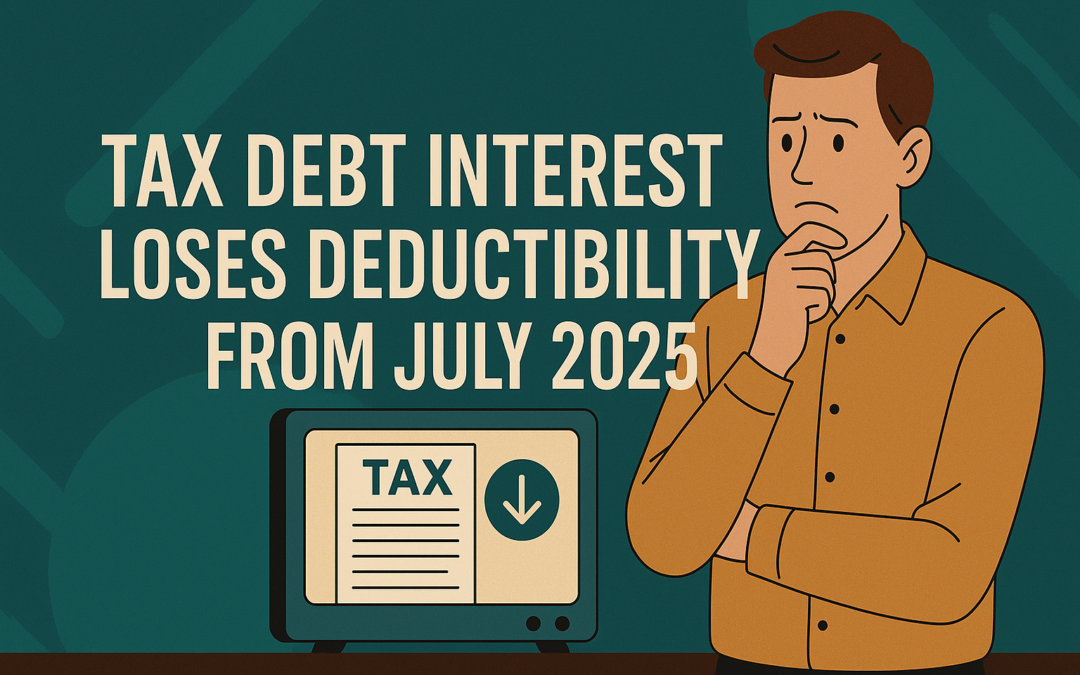
A critical legislative shift will significantly impact how Australian businesses manage tax debt costs
Starting 1 July 2025, the Australian Taxation Office (ATO) will implement a fundamental change to tax law that will affect thousands of businesses across the country. The ATO will no longer allow taxpayers to claim income tax deductions for interest charges on unpaid tax debts, marking a significant shift in how tax debt costs are treated.
This change applies to both the General Interest Charge (GIC) and the Shortfall Interest Charge (SIC) incurred on or after the effective date, representing one of the most impactful tax policy changes for businesses in recent years.
Understanding the Interest Charges
To fully grasp the implications of this change, it’s essential to understand how these interest charges work:
General Interest Charge (GIC) is applied daily to unpaid tax liabilities and is designed to encourage timely payment of taxes. As of March 2025, the GIC rate stands at 11.42%, compounding daily and making delays increasingly expensive for taxpayers.
Shortfall Interest Charge (SIC) is imposed when there’s a shortfall in tax payments due to an amended assessment. The SIC is calculated from the original due date until the shortfall is corrected, with the current rate at 7.17%.
These rates are significantly higher than most commercial lending rates, making tax debt an expensive proposition for businesses that fall behind on their obligations.
The Financial Impact on Businesses
Previously, businesses and individuals could claim deductions for these interest charges, effectively reducing the cost of late tax payments. This deductibility provided some relief for businesses struggling with cash flow issues or facing unexpected tax liabilities.
With the new legislation, any GIC or SIC incurred from 1 July 2025 onwards will be non-deductible, substantially increasing the after-tax cost of carrying tax debt.
To illustrate the impact, consider a business with a $50,000 tax debt that accrues $5,000 in GIC annually. Under the current rules, this business could deduct the $5,000, reducing their taxable income. For a business in the 25% tax bracket, this deduction saves $1,250 in taxes, making the effective cost $3,750.
Post-1 July 2025, this deduction will no longer be available, making the full $5,000 a direct, non-deductible expense. This represents a 33% increase in the real cost of carrying tax debt.
Strategies to Minimize the Impact
While this change will increase costs for businesses with tax debt, there are several strategies that can help mitigate the financial impact:
1. Prioritize Timely Tax Payments
The most effective strategy is ensuring all tax liabilities are paid on time to avoid incurring GIC or SIC altogether. This requires:
- Implementing robust cash flow management systems
- Setting up automatic payment arrangements with the ATO
- Creating dedicated tax reserve accounts
- Using quarterly tax calculators to estimate liabilities accurately
2. Explore Alternative Financing Options
Consider using business loans, overdrafts, or other commercial financing to pay tax debts. Interest on such loans remains tax-deductible, potentially offering a more cost-effective solution than allowing GIC to accrue.
For example, a business loan at 9% interest rate would have an effective after-tax cost of 6.75% (assuming a 25% tax rate), compared to the full 11.42% GIC rate that will no longer be deductible.
3. Review Existing Payment Arrangements
If you have existing ATO payment arrangements extending beyond 1 July 2025, it’s crucial to assess the financial impact of non-deductible interest and explore refinancing options. This might involve:
- Calculating the new effective cost of existing arrangements
- Exploring acceleration of payments before the July deadline
- Investigating refinancing through commercial lenders
4. Seek Professional Financial Advice
The complexity of this change and its potential impact makes professional advice more valuable than ever. Financial advisors and accountants can help develop strategies tailored to your specific circumstances, including:
- Cash flow forecasting and management
- Alternative financing structures
- Tax planning to minimize future liabilities
- Risk assessment and mitigation strategies
Preparing for the Change
Businesses should begin preparing for this change well before the July 2025 deadline. Key preparation steps include:
- Immediate assessment: Review current tax debt positions and payment arrangements
- Cost analysis: Calculate the potential increased cost under the new rules
- Strategic planning: Develop financing strategies that minimize the impact
- Implementation: Put new processes and arrangements in place before the deadline
How Sanford Finance Can Help
At Sanford Finance, we understand the challenges this legislative change may pose to Australian businesses. Our experienced team specializes in helping businesses navigate complex financial situations and can assist with:
- Debt refinancing solutions: Exploring commercial financing options to replace costly tax debt
- Cash flow management: Implementing systems to ensure timely tax payments
- Strategic planning: Developing comprehensive approaches to minimize the impact of these changes
- Alternative financing: Structuring cost-effective funding solutions for tax obligations
We work with a network of over 40 lenders to secure competitive rates and terms tailored to your specific situation, whether you need immediate funding for tax payments or longer-term arrangements to manage cash flow.
Take Action Now
Don’t wait until July 2025 to address these changes. The earlier you implement strategies to manage tax debt, the more you can minimize the financial impact on your business. With proper planning and the right financial partners, businesses can navigate this regulatory change while maintaining healthy cash flow and financial stability.
Contact Sanford Finance today:
Our Sydney-based team is ready to provide expert guidance on financing solutions and strategic planning to help your business stay ahead of these important changes. Book a consultation today to ensure your business remains financially resilient in the face of evolving tax regulations.
This information is general in nature and should not be considered as specific financial or tax advice. Tax laws and regulations are subject to change, and individual circumstances may vary. Always consult with qualified professionals before making financial decisions.

Jun 10, 2025 | Investment Property, Property Market, Purchasing, Uncategorized
Posted June 2, 2025 | By the Sanford Finance Team
That conversation you overheard at the local café wasn’t wrong — “Did you see what that place sold for on Miller Street?”
The numbers are in, and they’re eye-watering. Australian home prices have shattered records once again, with the national median hitting $831,288 in May 2025, according to fresh CoreLogic data.
We’re talking about 0.5% growth in just one month and a solid 3.3% climb over the past year. Every single capital city posted gains, with Darwin surging ahead at 1.6%, Perth close behind at 1.4%, and Brisbane rounding out the top three at 1.3%.
“This is the strongest market momentum we’ve witnessed since the rate hiking cycle kicked off in 2022,” explains Tim Lawless, CoreLogic’s Head of Research.
But what’s really driving this surge? Let’s dig into the details.
💰 The Rate Cut Effect Is Real
The RBA’s second rate cut this year — bringing the cash rate down to 3.85% — isn’t just making headlines. It’s fundamentally changing how people approach property.
“The expectation of more cuts to come is giving buyers serious confidence,” Lawless notes. “We’re seeing it play out in auction clearance rates and these consistent price rises.”
The banking response has been swift and decisive:
- Commonwealth Bank: Immediate cuts across variable and fixed products
- NAB & ANZ: Matching reductions on home loan rates
- Westpac: Full rate cuts rolling out from June 3rd
Translation? Borrowing is cheaper, buying power is stronger, and both first-time buyers and seasoned investors are jumping back into the market.
🏡 What Smart Buyers Are Doing Right Now
If property is on your radar — whether that’s next month or next year — strategic preparation is everything.
Here at Sanford Finance, we’re fielding calls from three distinct groups:
First-Home Buyers: Racing to secure finance while rates remain competitive and before prices climb further out of reach.
Property Upgraders: Leveraging the equity gains in their current homes to move into their “forever” properties.
Savvy Investors: Targeting regional powerhouses like Adelaide, Perth, and Hobart, where rental yields remain attractive and growth potential is strong.
The reality? Pre-approval isn’t just helpful anymore — it’s essential. We’re helping clients understand exactly what they can borrow, which government incentives they qualify for, and which lenders are offering the most competitive packages right now.
🛠️ The Refinancing Gold Rush
Here’s something interesting: thousands of Australians are refinancing simultaneously.
The motivation is clear — lock in lower rates, reduce monthly repayments, or extract equity for renovations, investments, or debt consolidation.
“The combination of falling rates and rising property values creates a perfect refinancing window,” says Ivo De Jesus, Director of Sanford Finance. “We’re regularly saving clients several hundred dollars monthly — in some cases, much more.”
The math is compelling. If your current rate is above 6%, you could be missing out on significant monthly savings that add up to thousands annually.
📈 Regional Markets Are the Hidden Winners
While Sydney and Melbourne grab the headlines, some of the smartest money is flowing into regional centers:
Adelaide: Steady growth with strong rental demand from interstate migration Perth: Resource sector recovery driving both employment and housing demand
Hobart: Limited supply meeting consistent demand from lifestyle seekers
These markets offer something the capitals struggle with — affordability combined with growth potential.
🎯 Your Strategic Options
Ready to Buy? Focus on pre-approval first, then target areas with strong fundamentals rather than just following price growth.
Considering Refinancing? With your property value likely higher and rates now lower, the numbers probably work in your favor.
Thinking Investment? Regional markets and emerging suburbs offer better entry points than established premium areas.
Planning Renovations? Rising property values mean your equity position is stronger — potentially unlocking funds for home improvements.
📊 The Bottom Line
Property prices are climbing, rates are falling, and opportunities are multiplying.
But here’s the thing — markets move fast, and the best opportunities don’t wait around.
Whether you’re ready to buy your first home, upgrade to something bigger, dive into investment property, or simply optimize your current mortgage, having expert guidance makes all the difference.
Ready to explore what’s possible?
📞 Call us today on (02) 9095 6888
📩 Or visit sanfordfinance.com.au to book your strategy session
Let’s turn these market conditions into your personal advantage.

May 30, 2025 | Bridging Loan, First Home Buyers, Investment Property, Property Market, Refinance
Posted May 30, 2025 | By the Sanford Finance Team
Breaking: Your Mortgage Just Got Cheaper Again
The RBA has delivered its second interest rate cut of 2025, reducing the official cash rate by another 0.25% to 3.85%.
What’s particularly noteworthy this time is how quickly the banks have responded – we’re seeing same-day rate cuts from the Big Four. It’s refreshing to see banks move this fast to pass on savings to customers.
Commonwealth Bank: “Done. May 30th. You’re welcome.” NAB: “Same day. Consider it handled.” ANZ: “May 30th. No waiting around.” Westpac: “June 3rd. Close enough to count.”
Even the smaller lenders are getting competitive with some fixed rates now sitting under 5%. It’s creating the most competitive mortgage market we’ve seen in years.
The Real Dollar Impact 💰
Let’s talk actual savings for your household budget:
Got a $500k mortgage? You just saved roughly $81 every single month. That’s nearly $1,000 back in your pocket every year.
Playing in the $1M league? We’re talking $162 monthly savings. Over a year, that’s almost $2,000 you can redirect toward that holiday fund, emergency stash, or just breathing a little easier.
But here’s an important note – some banks require you to contact them directly to adjust your repayments. Don’t assume the savings will automatically appear. Make sure to follow up with your lender.
The Concerning Reality: Mortgage Stress Is Still Rising
Despite the positive news, there’s a concerning trend in the data.
Despite TWO rate cuts this year, mortgage stress is actually going UP. We’re not making this up:
- 63% of mortgage holders are feeling the pinch (that’s UP from 59% last month)
- 1.4 million households are in genuine mortgage distress
- People are missing payments even as rates drop
What’s happening here? The reality is that if you’ve been struggling through two years of significant rate rises, two modest cuts might provide some relief but not complete recovery. The cumulative impact takes time to reverse.
The Tale of Two Australias
The data reveals something fascinating: Australia is splitting into mortgage winners and losers, and it’s not just about income.
The Struggle Streets:
- Craigieburn, VIC: 3.10% arrears rate (triple the national average!)
- Bateau Bay, NSW: Also in the danger zone
- These aren’t necessarily “poor” areas – they’re often filled with families who stretched to buy homes at peak prices
The Opportunity Zones: Meanwhile, savvy borrowers in competitive markets are using this environment to their advantage – refinancing, restructuring, even expanding their property portfolios.
Where You Stand: Three Common Situations
If you’re still struggling financially: Rate cuts help, but they may not be enough on their own. Consider exploring loan restructuring, refinancing options, or temporary relief measures like interest-only payments. Professional guidance can help identify the best path forward.
If you’re managing but it’s still tight: This rate environment gives you an opportunity to get ahead. Consider refinancing to better terms now, while the market is competitive.
If you’re in a strong position: Lower rates create opportunities for investment finance, business expansion, and portfolio optimization. It’s worth exploring how to make the most of this environment.
The Million-Dollar Question: What Happens Next?
Nobody has a crystal ball (if they say they do, run), but here’s what we’re watching:
The RBA is clearly in “support mode” rather than “emergency mode.” They’re not panicking about inflation anymore, which means they’ve got room to move if the economy needs more help.
But here’s the thing – this window won’t stay open forever. Economic cycles turn, global events happen, and what’s available today might not be available tomorrow.
Your Next Steps: Making Smart Decisions
If you’re struggling: Don’t wait for things to improve on their own. Explore your options now while you still have choices available.
If you’re stable: Consider whether you could optimize your loan structure to save more or position yourself better for the future.
If you’re doing well: This market presents significant opportunities for those who understand how to navigate it effectively.
Here’s What We’re Doing About It
At Sanford Finance, we’re not just watching this unfold – we’re helping people win in every scenario.
This week alone, we’ve helped:
- A tradie in Penrith restructure his loans and free up $400/month in cash flow
- A couple in Brisbane refinance and save enough to start their investment journey
- A small business owner in Perth access cheaper equipment finance to expand operations
The difference? They didn’t try to figure it out alone.
Ready to Take Action?
The market conditions are creating real opportunities, but they require the right approach and timing.
Book your free strategy session to review your specific situation and explore the options available in this changing market.
Sanford Finance – Smart Lending Solutions
Disclaimer: This information is general in nature and should not be considered personal financial advice. Individual results vary based on personal circumstances. Please consult with qualified professionals before making financial decisions. But seriously, don’t just sit there – take action.

May 21, 2025 | Interest rates, Investment Property, Property Market
The Wait Is Finally Over
After years of rising interest rates that have tested Australian households and businesses, the Reserve Bank of Australia (RBA) has finally delivered some welcome relief. In its May meeting, the RBA cut the official cash rate by 25 basis points to 3.85% – the first reduction in over two years.
This significant shift in monetary policy marks a turning point for borrowers across the country. But what does it mean for your finances, especially if you’re self-employed or running a small business? Let’s break it down.

Why Now? The Economic Picture
The RBA’s decision reflects growing confidence that inflation is finally under control. Recent data shows that core inflation has returned to the RBA’s target range of 2-3%, sitting at 2.9%. This crucial development has allowed the central bank to shift focus from fighting inflation to supporting economic growth.
Despite global uncertainties – including recent U.S. credit rating downgrades and ongoing trade tensions – Australia’s economy remains resilient:
- Unemployment is steady at 4.1%
- The labour market participation rate is strong at 67.1%
- Economic growth has slowed but remains positive
What This Means for Homeowners
If you’re currently paying off a mortgage, this rate cut could deliver meaningful savings:
- On a $500,000 loan, you could save approximately $76 per month (assuming lenders pass on the full cut)
- On a $1 million loan, potential monthly savings increase to about $152
For those who have been struggling with higher repayments over the past two years, this represents the first real relief in a challenging period. While one rate cut won’t completely offset previous increases, it signals a potential change in direction that could lead to further cuts later this year.
Self-Employed Australians: Your Opportunity Window
If you’re self-employed or running a small business, this rate cut opens several strategic opportunities:
1. Business Expansion
Lower interest rates make business loans more affordable, potentially enabling expansion plans that may have been on hold during the higher rate environment.
2. Equipment and Vehicle Finance
If you’ve been delaying purchases of new equipment, vehicles, or other business assets, now could be an ideal time to reassess. With improved borrowing conditions, asset finance options become more attractive.
3. Refinancing Existing Debt
Many self-employed Australians have been carrying higher-interest debt through the rate hiking cycle. The new environment creates favourable conditions for consolidating or refinancing this debt.
Looking Ahead: Will Rates Fall Further?
While the RBA has made its first move, economists remain divided on the pace of future cuts. Our analysis suggests:
- The next rate cut could come as soon as August, depending on inflation data
- A more conservative scenario would see another cut in November
- By mid-2026, we could see the cash rate settling between 3.0-3.5%
The RBA has made it clear that future decisions will depend on economic data, particularly inflation figures and employment statistics.
How Sanford Finance Can Help
As specialists in lending solutions for self-employed Australians and small business owners, we’re uniquely positioned to help you navigate this changing interest rate environment:
- Home Loan Review: Let us assess your current mortgage and identify potential savings through refinancing
- Business Lending Solutions: Access our network of over 40 lenders who understand the unique needs of self-employed professionals
- Asset Finance: Explore competitive rates on equipment, vehicle, and other asset purchases
- Strategic Planning: Develop a financing strategy that takes advantage of the current rate environment
Take Action Now
The rate cut environment won’t last forever, and taking action now could secure you significant savings over the life of your loans.
Contact our team today for a no-obligation review of your financial position. We’ll provide clear, straightforward advice on how to make the most of this shifting rate environment.
Sanford Finance – Smart Lending for Self-Starters
Disclaimer: This information is general in nature and does not take into account your personal financial situation. It is provided for educational purposes and should not be considered financial advice. Please consult with a financial professional before making any financial decisions.
May 1, 2025 | Bridging Loan, Debt Consolidation, First Home Buyers, Investment Property, Property Market, Self Managed Super Fund (SMSF)
Inflation has fallen below 3%, setting the stage for potential RBA rate cuts. While 1.45 million Australians still face mortgage stress, the changing economic landscape offers new opportunities in refinancing, SMSF property investment, bridging finance, and debt consolidation. Now is the ideal time to review your mortgage strategy.
The economic tide is finally turning for Australian borrowers. With inflation easing below 3% for the first time in two years and the Reserve Bank of Australia (RBA) hinting at rate cuts, May 2025 could mark a pivotal moment for homeowners and investors alike. After an extended period of high interest rates, it’s time to reassess your mortgage strategy and position yourself for the changing financial landscape.
Current Economic Climate: A Shifting Landscape
Recent data reveals that Australia’s core inflation, measured by the RBA’s preferred trimmed mean, has fallen to 2.9%—finally within the central bank’s 2–3% target range for the first time since late 2021. Headline inflation remains steady at 2.4% annually. These figures strengthen expectations for potential interest rate cuts in the coming months.
However, despite this positive outlook, many Australians continue to grapple with financial pressure. As of March 2025, approximately 1.45 million mortgage holders are still considered “at risk,” with 990,000 classified as “extremely at risk.” While these numbers represent a modest decline following the RBA’s February adjustments, they highlight the ongoing strain on household budgets.
What This Means for Different Borrowers
For Existing Homeowners
If you’ve been feeling trapped in “mortgage prison” due to tightened lending standards and property valuation drops, the climate is changing. With inflation under control and potential rate cuts on the horizon, lenders may start easing their assessment criteria. This could open refinancing opportunities that weren’t available during the high-rate environment.
For Property Investors
The investment landscape is showing early signs of activity. National Australia Bank (NAB) reported that demand for financed vehicles and equipment rose about 10% nationally in 2023 despite higher rates, indicating growing business confidence. This economic resilience may translate to increased stability in the property investment market as well.
For Self-Managed Super Fund (SMSF) Investors
SMSFs continue to represent a significant avenue for property investment. According to the ATO, SMSFs held substantial cash investments as of late 2024, indicating strong positioning to capitalize on property opportunities. However, be aware of proposed regulatory changes, including the potential Division 296 tax on superannuation balances exceeding $3 million (scheduled for July 2025).
Strategic Options to Consider This May
1. Refinancing Smarter, Not Harder
With economic indicators improving, May 2025 presents an opportune moment to review your mortgage. You may now qualify for better terms than 12 months ago, even if you were previously rejected for refinancing. Banks are also competing more aggressively for quality borrowers as their lending appetite returns. Explore your options with Sanford Finance’s refinancing services.
2. Reassessing Fixed vs. Variable Loans
The fixed-rate mortgage cliff that dominated headlines in 2023–24 has largely passed, but the question remains relevant: should you fix your rate now or stay variable to benefit from potential rate cuts? The answer depends on your financial situation, but with cuts potentially on the horizon, variable rates may offer more immediate benefits for many borrowers. Sanford Finance provides insights on managing expiring fixed rates.
3. Using SMSFs for Property Investment
SMSFs continue to be powerful vehicles for property investment, offering benefits like lower tax rates on rental income (15% or potentially 0% in retirement phase) and reduced capital gains tax implications. However, with increased ATO scrutiny on SMSF compliance—particularly regarding asset valuations and investment strategy diversification—proper professional guidance is essential. Learn more about purchasing property through an SMSF.
The ATO has intensified its focus on SMSF investment strategies, requiring them to be tailored to specific circumstances rather than using generic documents. As a trustee, regularly reviewing and updating your investment strategy is not just best practice—it’s a legal requirement.
4. Exploring Bridging Finance Solutions
Bridging loans have seen surging demand, with some non-bank lenders reporting a 360% increase in the first quarter of the 2025 financial year compared to 2023–24. These short-term financing solutions can be invaluable if you’re looking to seize a property opportunity before selling your existing home.
5. Debt Consolidation to Improve Cashflow
With the rising cost of living affecting household budgets, consolidating multiple debts into your mortgage could significantly improve your monthly cashflow. This strategy can be particularly effective as we transition to a potentially lower interest rate environment.
Moving Forward: What Should You Do Now?
Whether you’re feeling trapped by your current mortgage terms, considering an investment opportunity, or simply want to ensure you’re positioned optimally for the changing market, May 2025 is an ideal time to review your financial strategy.
The recovery from the post-COVID interest rate surge has been long and challenging for many Australian borrowers. As the RBA’s Assistant Governor Brad Jones noted in April 2024, “Small business lending has not grown over the past year,” and many SMEs have reported “significant challenges accessing bank funding on suitable terms.” However, major banks are now signaling a renewed appetite for lending, with Westpac remarking that “there’s never been a better time to say we’re open for business.”
For homeowners and investors alike, this shift in the lending environment creates both opportunities and complexities. Professional guidance has never been more valuable.
At Sanford Finance, we specialize in navigating these complex financial waters. Our team keeps abreast of regulatory changes, lending criteria shifts, and market opportunities to provide tailored advice for your specific situation.
Whether you’re interested in refinancing options, SMSF property strategies, or exploring how to leverage the changing interest rate environment to your advantage, we’re here to help you make informed decisions.
Contact Sanford Finance today for a no-obligation review of your lending strategy and position yourself to benefit from the changing financial landscape of 2025.
Note: This article is for informational purposes only and does not constitute financial advice. Please consult with a financial advisor to discuss your specific circumstances.
Page 5 of 6« First«...23456»