

SMSF Property Lending: Major Changes Proposed — What You Need To Do Now
Important Notice: The measures discussed are proposed changes agreed between the Government and the Greens on 23 June 2026. The amendment is expected to pass the Senate in early July 2026 and commence 45 days after Royal Assent — approximately mid-August 2026. Seek professional advice immediately if you are mid-purchase or planning to purchase residential property in an SMSF.
What’s changing
On 23 June 2026, Prime Minister Anthony Albanese and Treasurer Jim Chalmers confirmed they have agreed to an amendment that will ban SMSFs from entering new limited recourse borrowing arrangements (LRBAs) to acquire residential property. The change was the price the Greens demanded for their Senate support of the Government’s broader Treasury Laws Amendment (Tax Reform No. 1) Bill 2026 — the legislation that overhauls the CGT discount and negative gearing rules.
This is a significant reversal of Labor’s previous position. As recently as May 2025, the Government stated it had “no intention” of banning LRBAs. That position has now changed.
What’s still allowed
Crucially, the ban is narrow in scope. Several SMSF property strategies remain fully available — and for many clients these alternatives will continue to be effective ways to hold property inside super.
- SMSF cash purchase — residential property: An SMSF with sufficient cash can still purchase residential property outright. No borrowing means the LRBA rules do not apply. The concessional tax treatment inside super remains — 15% on income, 10% on capital gains held more than 12 months, and 0% once the fund is in pension phase within the transfer balance cap.
- SMSF LRBA — commercial property: Borrowing to acquire commercial property (technically, “business real property”) remains available. This includes warehouses, offices, factories, and retail. The “business real property” test is specific — do not assume any non-residential property automatically qualifies. Get advice on the specific property you have in mind.
- Existing SMSF LRBAs — grandfathered: If your SMSF already has an LRBA in place for residential property, nothing changes. Existing arrangements continue under the current rules.
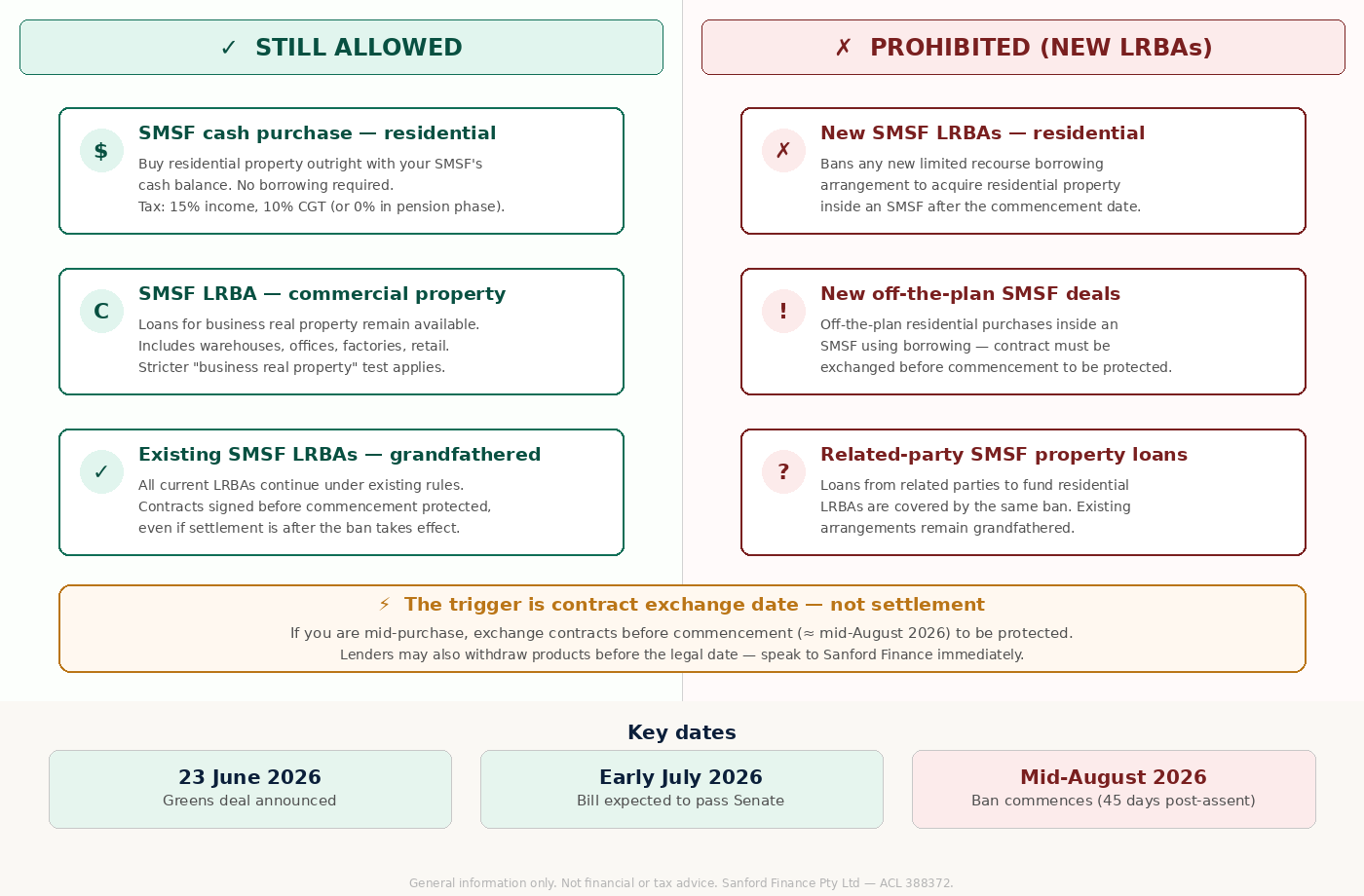
What’s still allowed vs. what’s prohibited under the proposed SMSF LRBA ban
The deadline that matters: contract exchange — not settlement
The legislation is explicit on this point. If you enter into an acquisition arrangement (exchange contracts) before the commencement date, you are protected — even if settlement happens after the ban takes effect.
The commencement date is 45 days after Royal Assent. The bill is expected to pass the Senate before the end of next week, putting the effective ban date in approximately mid-August 2026.
The commercial deadline is shorter than the legal one: The practical risk is not the legal deadline — it is the lenders. When Bill Shorten floated a similar policy in 2019, all four major banks withdrew their SMSF residential lending products before any law passed. We expect lenders to begin pulling SMSF residential products immediately. If you are mid-purchase, contact Sanford Finance now — not in August.
Who needs to act now
- Mid-process clients: If you are currently in the process of buying residential property inside your SMSF using borrowings, exchange contracts as quickly as possible.
- Off-the-plan buyers: Off-the-plan residential purchases inside an SMSF using borrowing must have contracts exchanged before commencement to be protected.
- Related-party loans: Related-party loan structures used to fund residential LRBAs are covered by the same ban. The same contract-date deadline applies.
Who is not affected
- Existing LRBA holders: If your SMSF already has an LRBA in place for residential property, the ban does not apply to you. Existing arrangements are fully grandfathered.
- Outright cash buyers: If you have sufficient cash in your SMSF to purchase residential property outright, you can proceed normally. The ban applies only to borrowing arrangements.
- Commercial property investors: Commercial LRBAs remain available, subject to the existing “business real property” rules.
What about the broader tax changes?
The wider Treasury Laws Amendment (Tax Reform No. 1) Bill 2026 — which overhauls the 50% CGT discount and tightens negative gearing — is now expected to pass the Senate before the end of next week. Importantly, superannuation, including SMSFs, was deliberately excluded from the CGT changes and continues to receive its existing concessional tax treatment — an effective 10% rate on realised capital gains, and a zero rate for retirees over 60 when the fund is in pension phase.
This means SMSFs holding residential property — whether purchased outright with cash or through an existing grandfathered LRBA — continue to enjoy a tax advantage relative to property held individually under the new rules.
Talk to Sanford Finance immediately: If you are mid-purchase, planning a purchase, or unsure how these proposed changes affect your existing structure, contact us today. We are already in discussion with our specialist SMSF lenders about product availability and timing. Call (02) 9095 6888 or visit sanfordfinance.com.au. Time is critical — the commercial deadline may be weeks ahead of the legal one.
Disclaimer: This article provides general information only and has been prepared without taking into account your objectives, financial situation or needs. The measures discussed are proposed changes agreed between the Government and the Greens on 23 June 2026 and are subject to passage through the Senate. This article does not constitute financial, tax or legal advice. Always seek advice from a qualified accountant, financial adviser or lawyer before making any decisions about your SMSF. Sanford Finance Pty Limited — Australian Credit Licence 388372 — ABN 50 117 771 187.
