Higher rates, gloomy budgets and cost-of-living pressure make for scary reading. But for long-term investors, Australia’s structural housing fundamentals point to opportunity for those who choose the right property in the right market.
The noise versus the numbers
Open any news app and Australian property looks like a minefield: higher interest rates, federal budget pessimism and relentless cost-of-living pressure. Yet the same period has seen national dwelling values continue their long-run climb, rents rise and a growing population competing for too few homes.
The lesson for long-term investors is simple: headlines are written to sell stories; data is what reveals reality. Short-term sentiment and long-term fundamentals are two very different things — and only one of them builds wealth over decades.
This issue looks at what the primary Australian data actually says about population, supply and rental demand, why periods of pessimism can favour disciplined buyers, and why the property and the market you choose matter far more than trying to time the cycle.
Four numbers that outlast the news cycle
~27.8 millionNational population
~1.5%Annual population growth
~79,000 homesProjected net housing shortfall to 2029
~5%+Long-run capital city capital growth (p.a.)
Demand: more people, fewer homes
Australia’s population continues to grow, driven largely by net overseas migration. According to the Australian Bureau of Statistics (ABS), the national population is now approximately 27.8 million, growing at around 1.5% annually — with net overseas migration the largest contributor.
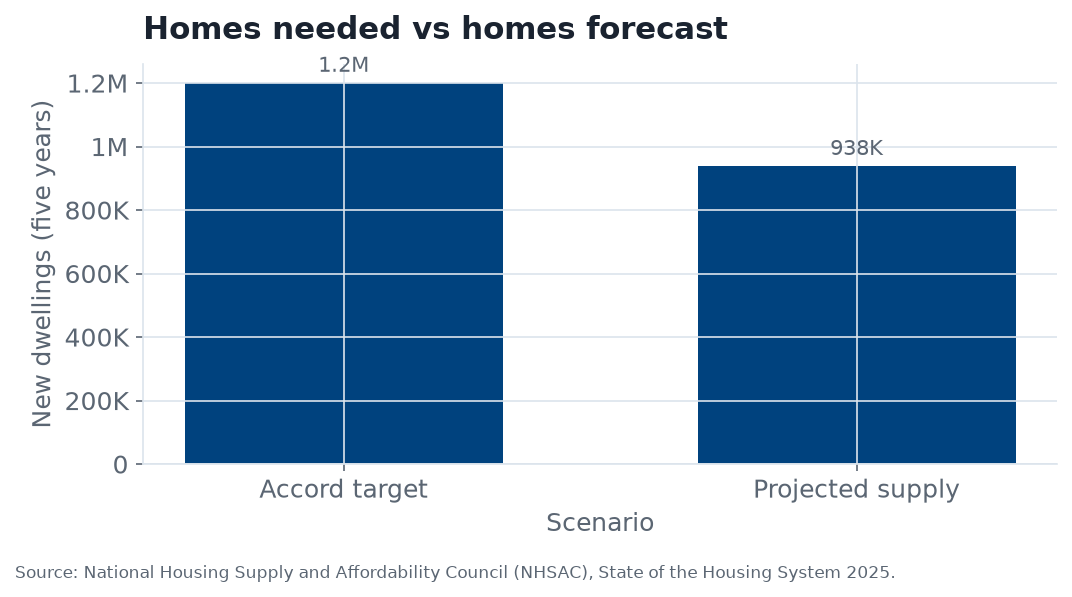
More people need somewhere to live, but new supply keeps falling behind. The National Housing Supply and Affordability Council (NHSAC) projects Australia will fall well short of the National Housing Accord target of 1.2 million homes: the forecast shortfall against the target is around 262,000 dwellings, and after allowing for demolitions, net housing supply is still expected to fall about 79,000 dwellings short of underlying demand by 2029.
When persistent demand meets constrained supply, the long-run pressure on prices and rents is structural — not a headline that disappears next quarter.
The supply gap the headlines ignore
The National Housing Accord set a target of 1.2 million new well-located homes over five years from mid-2024. The NHSAC projects around 938,000 completions — roughly 262,000 below the target. Measured as net supply against underlying demand, the shortfall is about 79,000 dwellings by 2029.
National Housing Supply and Affordability Council (NHSAC), State of the Housing System 2025.
Rental demand keeps the pressure on
Tight supply shows up first in the rental market. National vacancy rates have sat well below the level generally considered balanced (around 3%), and asking rents have risen substantially over recent years, according to CoreLogic data.
For investors, this is the tangible side of the fundamentals: strong tenant demand, low vacancy and rising rents support holding costs — provided you own the right asset in the right location.
Why pessimism can be an opportunity
Higher interest rates and budget gloom feel like reasons to wait. History suggests the opposite can be true for the disciplined:
Sentiment is cyclical; fundamentals are structural. Rate cycles come and go, but population growth and undersupply persist.
Fear thins the field. When headlines scare hesitant buyers to the sidelines, committed long-term investors face less competition.
Time in the market beats timing the market. Trying to pick the exact bottom is a losing game; consistent long-run participation is what has historically compounded wealth.
The Reserve Bank of Australia (RBA) sets the cash rate to manage inflation, and rate settings move through cycles. A single point in the cycle should not dictate a multi-decade investment strategy.
The core idea
Headlines sell stories. Data reveals reality.
— MVP Insight
Selection beats timing: the right property, the right market
National averages hide enormous variation. In any given year, some suburbs surge while others stall — even within the same city. That’s why which property, in which market matters far more than the month you buy.
Getting selection right means understanding:
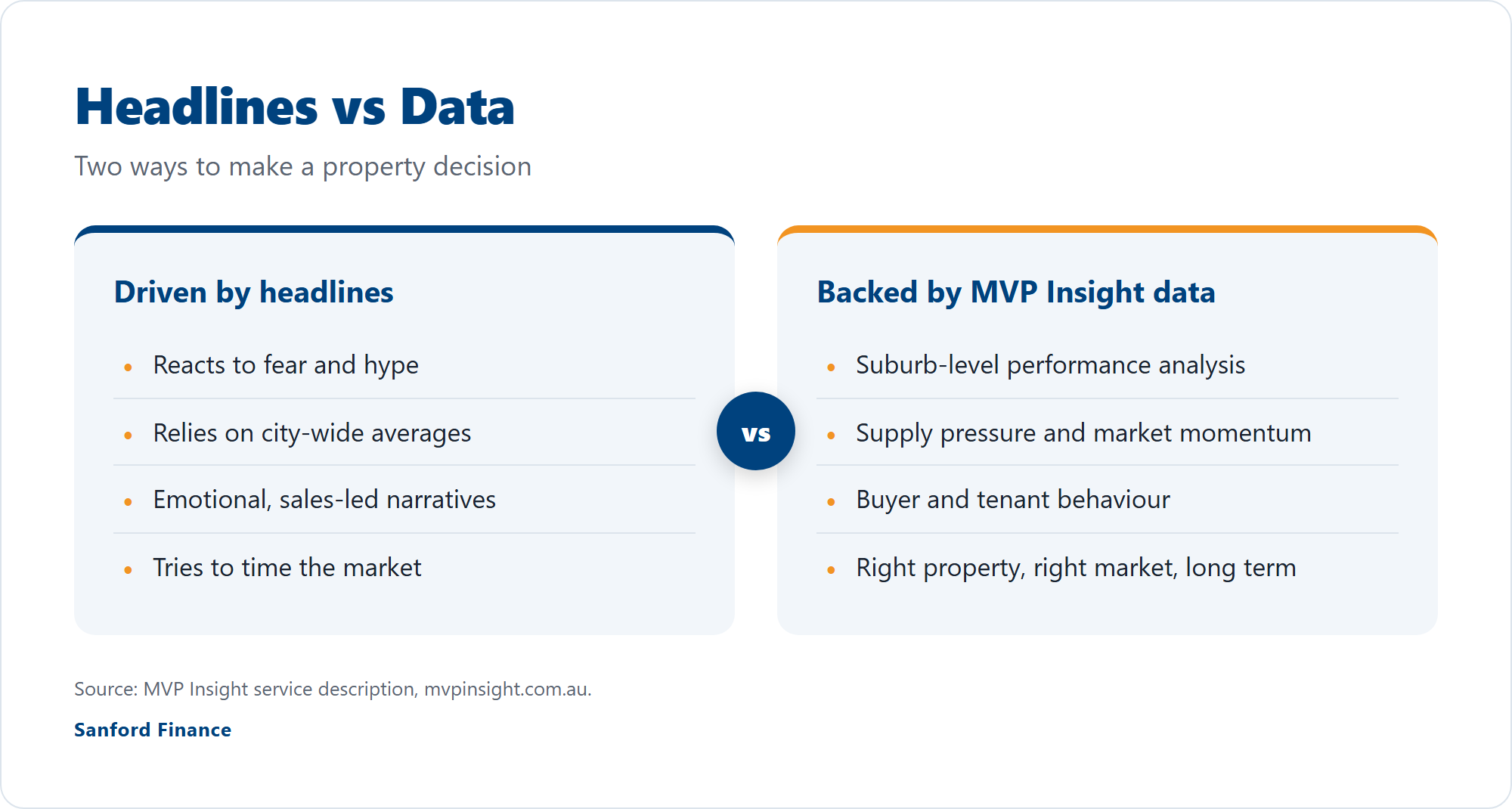
Suburb performance and momentum, not just city-wide averages
Supply pressure — what’s being approved and built nearby
Buyer and tenant behaviour driving real demand
Asset quality at the individual property level
This is analysis, not intuition. Emotion and sales-driven narratives are exactly what long-term investors need to filter out.
Two ways to choose a property
MVP Insight — Sanford Finance’s independent partner — replaces guesswork with evidence: Smarter Property Decisions. Backed by Insight.
mvpinsight.com.au
How MVP Insight finds the RIGHT property
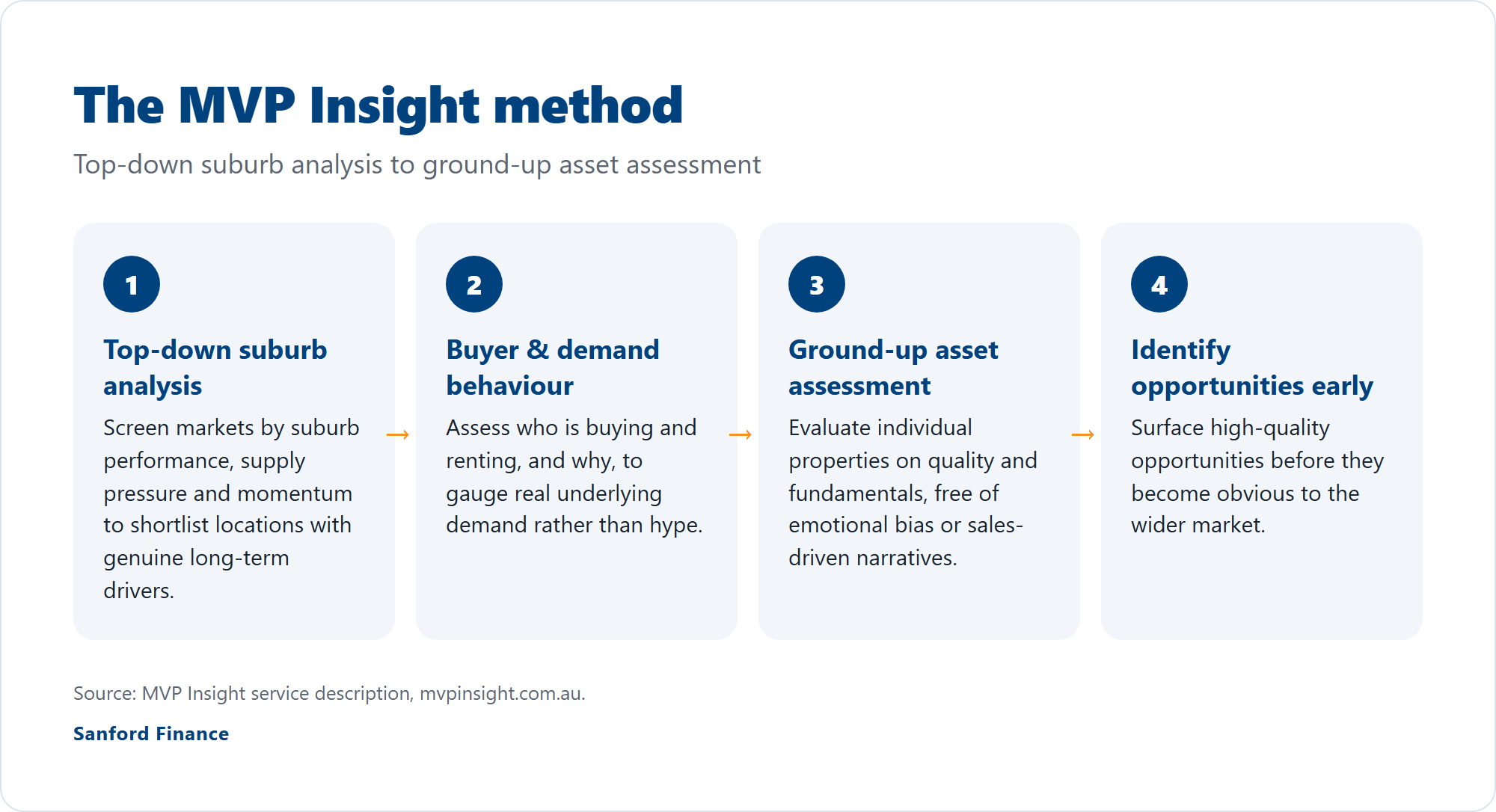
MVP Insight combines a top-down view of the market with a ground-up view of the individual asset — analysing suburb performance, buyer behaviour, supply pressure and market momentum to identify high-quality opportunities before they become obvious, without emotional bias or sales-driven narratives.
mvpinsight.com.au
Find the right property. Fund it well.
This is where the pairing works for you:
MVP Insight is an independent, data-driven property investment advisory and market-intelligence service. Its role is to help you find the right property in the right market — using data on suburb performance, buyer behaviour, supply pressure and market momentum, free of emotional bias or sales-driven narratives.
Sanford Finance helps you fund it — structuring finance that supports a disciplined, long-term strategy.
Independent data to choose the asset; the right finance to acquire and hold it. Together, that’s a strategy built on evidence rather than headlines.
This information is general only and does not take into account your objectives, financial situation or needs. It is not credit assistance or personal advice. Consider whether it is appropriate for you and seek professional advice before acting. Sanford Finance Pty Ltd — Australian Credit Licence 388372.
Division 296 took effect on 1 July 2026, but a late redesign dropped its most controversial feature. Here’s where it landed and who it actually affects.
After nearly three years of debate, the Division 296 tax on large superannuation balances is now law and applies from the 2026-27 financial year. But the version that passed is materially different from the one that caused so much alarm. If you or your clients hold a total super balance approaching $3 million, this is worth reading closely.
The numbers that matter
$3MBalance threshold
30%Total rate, $3–10M
40%Total rate, over $10M
1 Jul 2026Starts
How the tax actually works
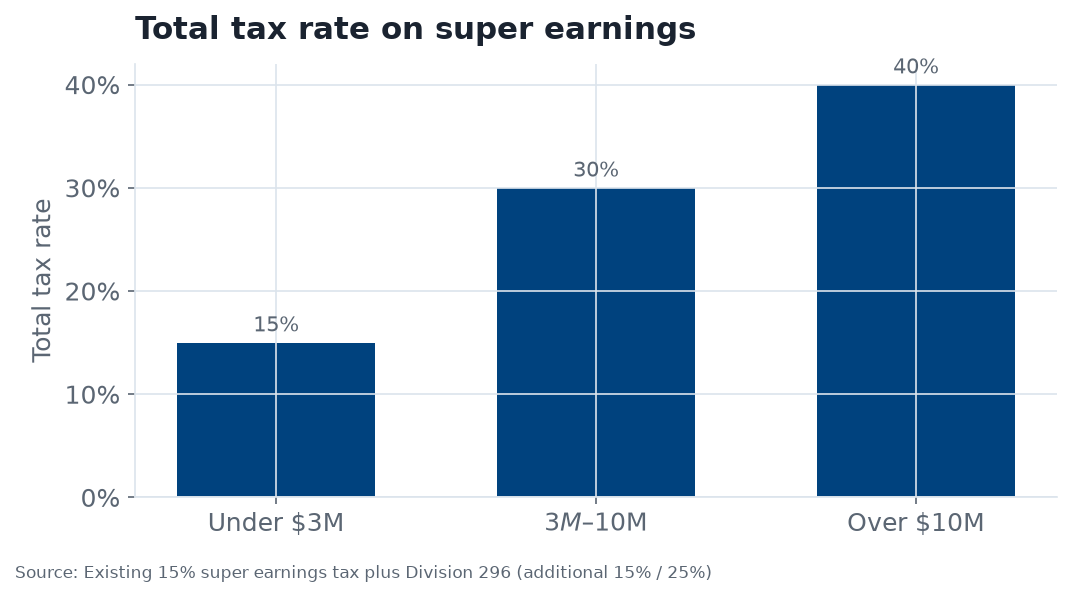
Division 296 sits on top of the existing 15% tax on super earnings. It imposes additional tax only on the proportion of a member’s earnings that relates to the portion of their Total Super Balance above the relevant threshold — not the whole balance. An extra 15% applies to earnings attributable to the slice between $3m and $10m, for a 30% total rate on that portion. Members with balances above $10m pay an additional 25% on earnings attributable to the balance above $10m, for a 40% total rate on that portion. Both thresholds are indexed to CPI, in $150,000 and $500,000 steps respectively.
Total tax rate on earnings, by balance tier
The additional tax is tiered, and the ATO calculates it from your Total Super Balance across all your funds — not separately for each fund. Earnings on the first $3 million keep the standard concessional rate.
Existing 15% super earnings tax plus Division 296 (additional 15% / 25%)
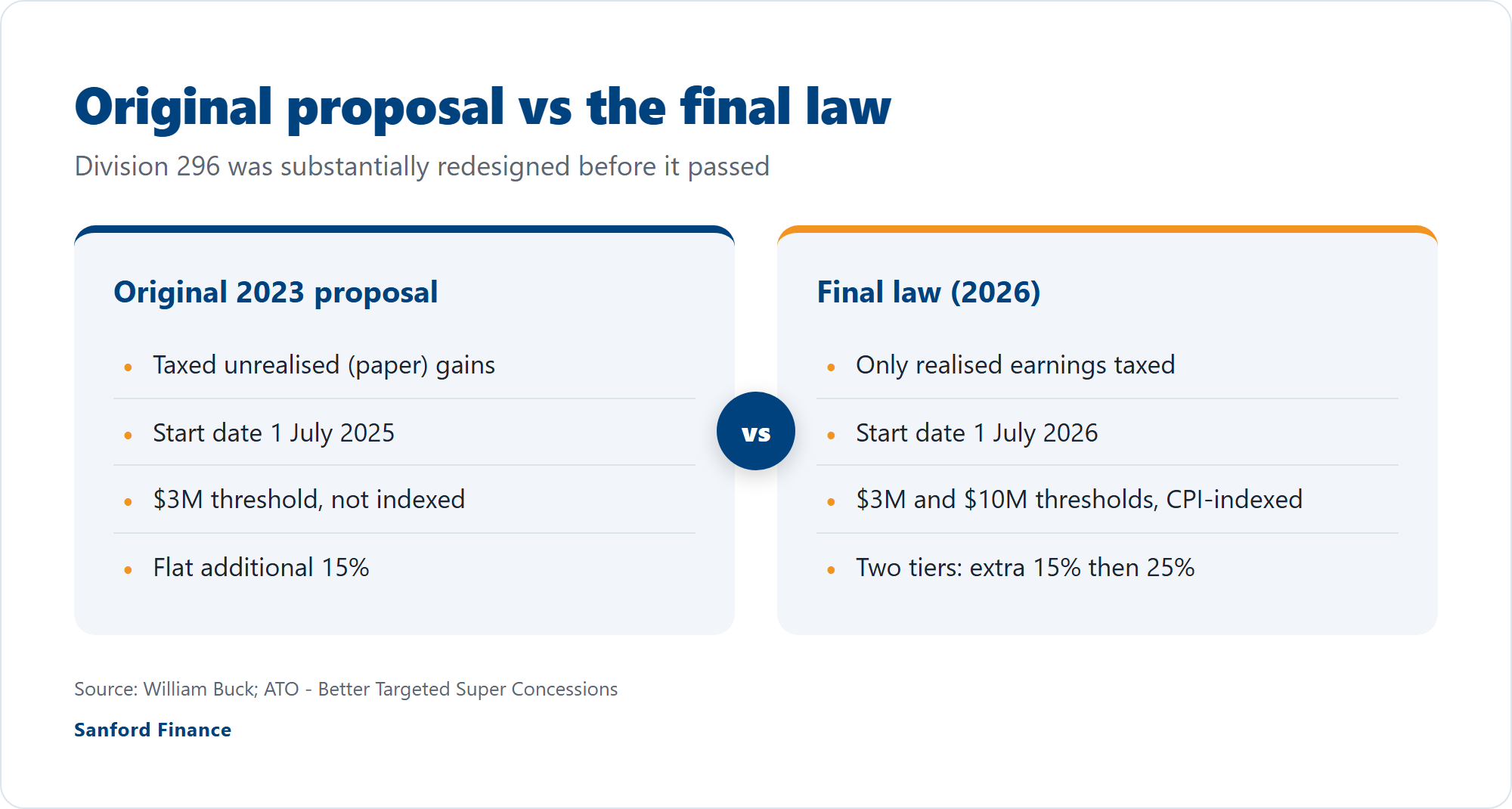
What changed between the draft and the law
William Buck; ATO — Better Targeted Super Concessions
The big reversal: no tax on unrealised gains
The original design would have taxed unrealised gains — paper increases in the value of assets you still hold. That drew heavy criticism, particularly for SMSFs holding property or farmland. The final law drops it entirely: only realised earnings — interest, dividends, rent and realised capital gains — are counted.
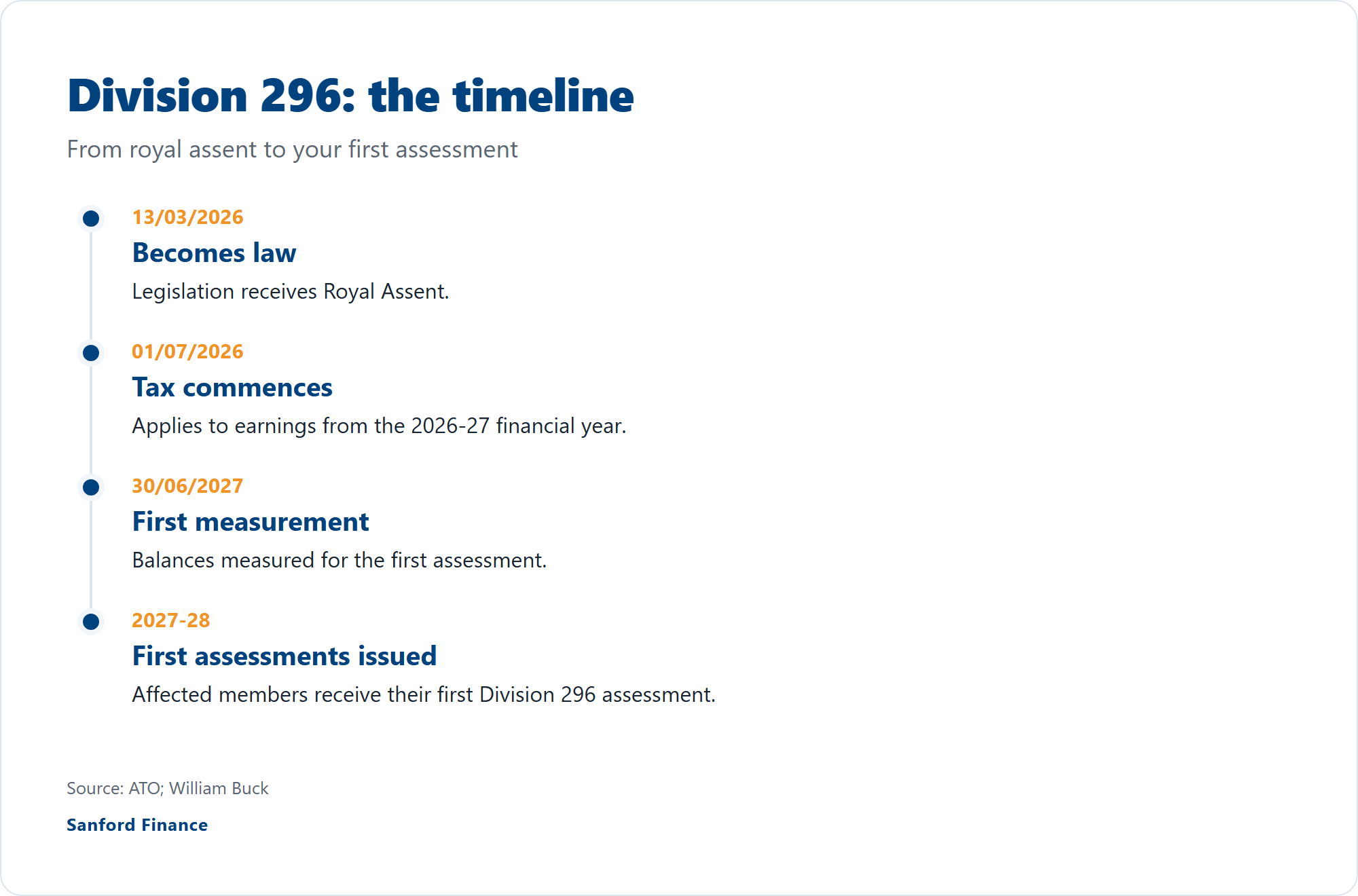
The dates to have in your diary
The first measurement date is 30 June 2027, with the first Division 296 assessments expected during the 2027–28 financial year.
ATO; William Buck
What to think about now
There is no need to panic, but there is time to plan. Members approaching or exceeding the threshold may wish to review their contribution strategy, asset location and the timing of asset disposals with their financial adviser or tax professional. As always, the right answer depends on your circumstances — this is general information, not personal advice.
This information is general only and does not take into account your objectives, financial situation or needs. It is not credit assistance or personal advice. Consider whether it is appropriate for you and seek professional advice before acting. Sanford Finance Pty Ltd — Australian Credit Licence 388372.
Important Notice: The measures discussed are proposed changes agreed between the Government and the Greens on 23 June 2026. The amendment is expected to pass the Senate in early July 2026 and commence 45 days after Royal Assent — approximately mid-August 2026. Seek professional advice immediately if you are mid-purchase or planning to purchase residential property in an SMSF.
What’s changing
On 23 June 2026, Prime Minister Anthony Albanese and Treasurer Jim Chalmers confirmed they have agreed to an amendment that will ban SMSFs from entering new limited recourse borrowing arrangements (LRBAs) to acquire residential property. The change was the price the Greens demanded for their Senate support of the Government’s broader Treasury Laws Amendment (Tax Reform No. 1) Bill 2026 — the legislation that overhauls the CGT discount and negative gearing rules.
This is a significant reversal of Labor’s previous position. As recently as May 2025, the Government stated it had “no intention” of banning LRBAs. That position has now changed.
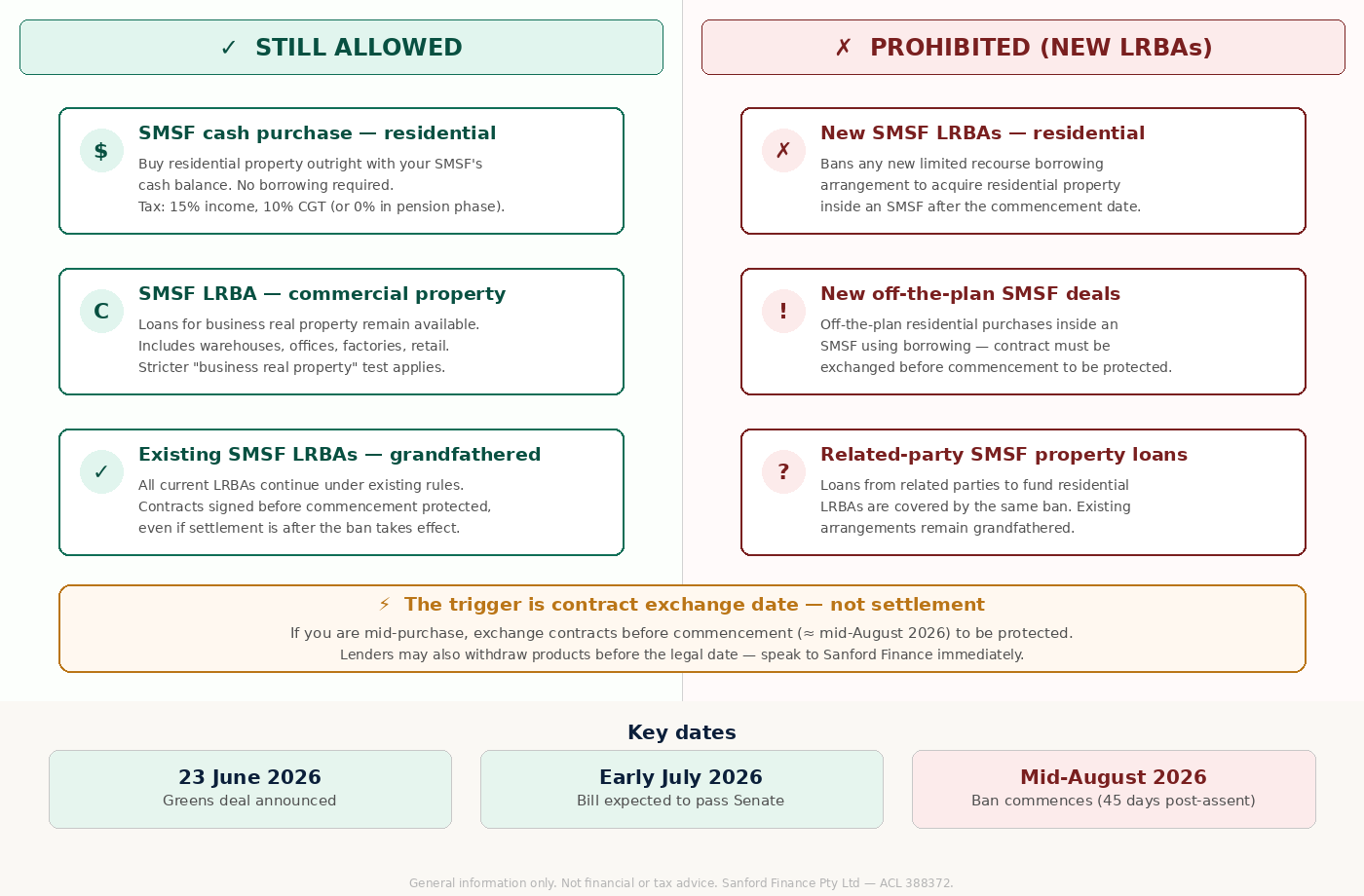
What’s still allowed
Crucially, the ban is narrow in scope. Several SMSF property strategies remain fully available — and for many clients these alternatives will continue to be effective ways to hold property inside super.
SMSF cash purchase — residential property: An SMSF with sufficient cash can still purchase residential property outright. No borrowing means the LRBA rules do not apply. The concessional tax treatment inside super remains — 15% on income, 10% on capital gains held more than 12 months, and 0% once the fund is in pension phase within the transfer balance cap.
SMSF LRBA — commercial property: Borrowing to acquire commercial property (technically, “business real property”) remains available. This includes warehouses, offices, factories, and retail. The “business real property” test is specific — do not assume any non-residential property automatically qualifies. Get advice on the specific property you have in mind.
Existing SMSF LRBAs — grandfathered: If your SMSF already has an LRBA in place for residential property, nothing changes. Existing arrangements continue under the current rules.
What’s still allowed vs. what’s prohibited under the proposed SMSF LRBA ban
The deadline that matters: contract exchange — not settlement
The legislation is explicit on this point. If you enter into an acquisition arrangement (exchange contracts) before the commencement date, you are protected — even if settlement happens after the ban takes effect.
The commencement date is 45 days after Royal Assent. The bill is expected to pass the Senate before the end of next week, putting the effective ban date in approximately mid-August 2026.
The commercial deadline is shorter than the legal one: The practical risk is not the legal deadline — it is the lenders. When Bill Shorten floated a similar policy in 2019, all four major banks withdrew their SMSF residential lending products before any law passed. We expect lenders to begin pulling SMSF residential products immediately. If you are mid-purchase, contact Sanford Finance now — not in August.
Who needs to act now
Mid-process clients: If you are currently in the process of buying residential property inside your SMSF using borrowings, exchange contracts as quickly as possible.
Off-the-plan buyers: Off-the-plan residential purchases inside an SMSF using borrowing must have contracts exchanged before commencement to be protected.
Related-party loans: Related-party loan structures used to fund residential LRBAs are covered by the same ban. The same contract-date deadline applies.
Who is not affected
Existing LRBA holders: If your SMSF already has an LRBA in place for residential property, the ban does not apply to you. Existing arrangements are fully grandfathered.
Outright cash buyers: If you have sufficient cash in your SMSF to purchase residential property outright, you can proceed normally. The ban applies only to borrowing arrangements.
Commercial property investors: Commercial LRBAs remain available, subject to the existing “business real property” rules.
What about the broader tax changes?
The wider Treasury Laws Amendment (Tax Reform No. 1) Bill 2026 — which overhauls the 50% CGT discount and tightens negative gearing — is now expected to pass the Senate before the end of next week. Importantly, superannuation, including SMSFs, was deliberately excluded from the CGT changes and continues to receive its existing concessional tax treatment — an effective 10% rate on realised capital gains, and a zero rate for retirees over 60 when the fund is in pension phase.
This means SMSFs holding residential property — whether purchased outright with cash or through an existing grandfathered LRBA — continue to enjoy a tax advantage relative to property held individually under the new rules.
Talk to Sanford Finance immediately: If you are mid-purchase, planning a purchase, or unsure how these proposed changes affect your existing structure, contact us today. We are already in discussion with our specialist SMSF lenders about product availability and timing. Call (02) 9095 6888 or visit sanfordfinance.com.au. Time is critical — the commercial deadline may be weeks ahead of the legal one.
Disclaimer: This article provides general information only and has been prepared without taking into account your objectives, financial situation or needs. The measures discussed are proposed changes agreed between the Government and the Greens on 23 June 2026 and are subject to passage through the Senate. This article does not constitute financial, tax or legal advice. Always seek advice from a qualified accountant, financial adviser or lawyer before making any decisions about your SMSF. Sanford Finance Pty Limited — Australian Credit Licence 388372 — ABN 50 117 771 187.
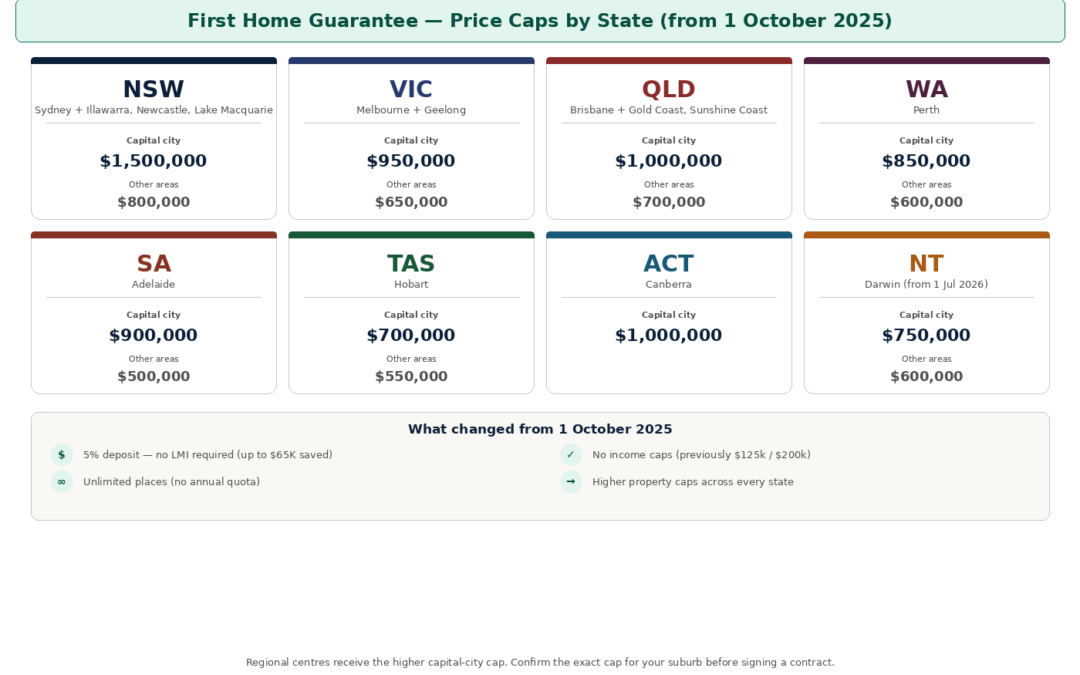
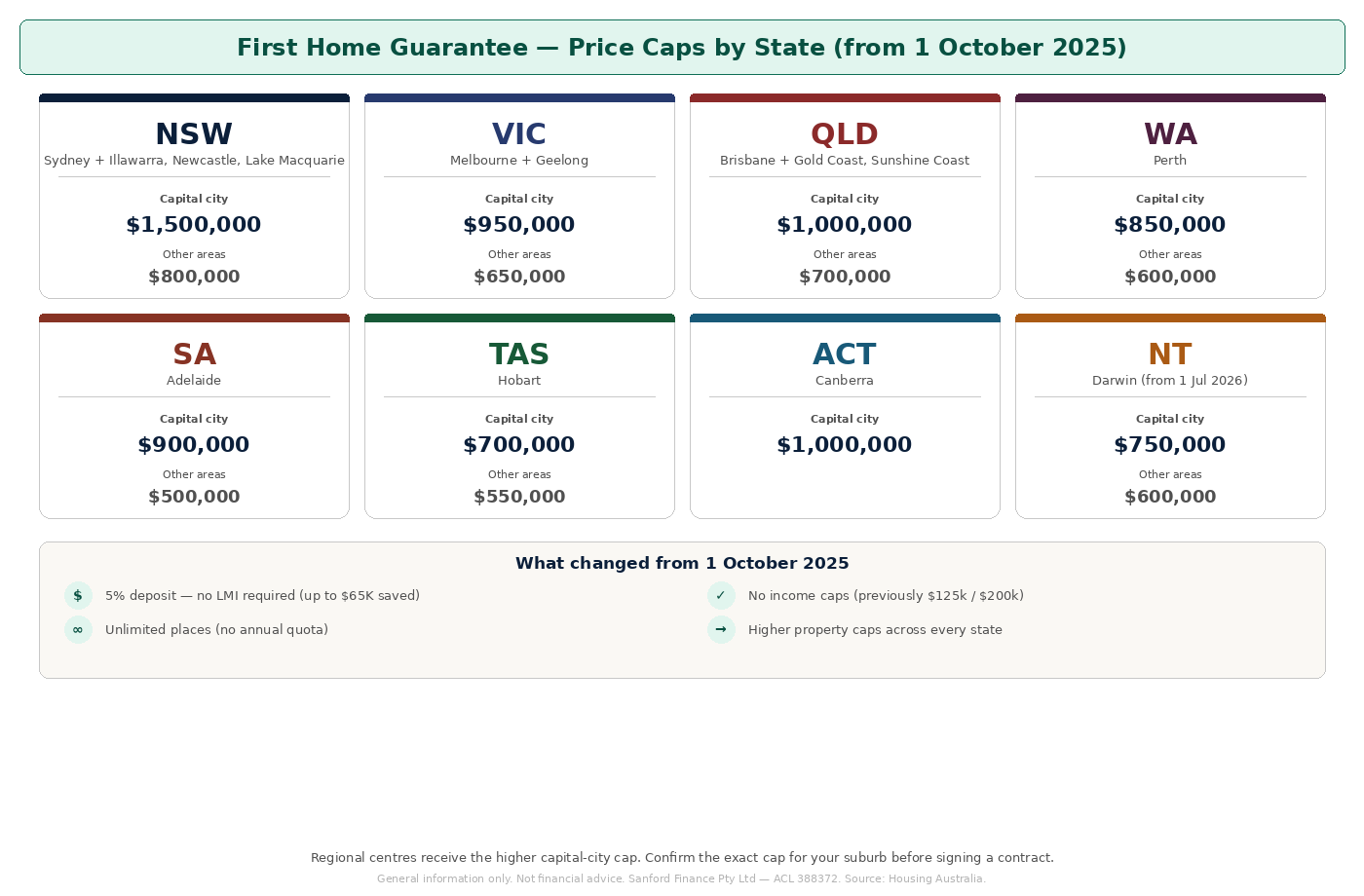
Quick summary: 5% deposit. No Lenders Mortgage Insurance. No income cap. No place limit. Price caps vary by state — see the table and diagram below. If your suburb is under the cap, you likely qualify.
How the scheme works
The First Home Guarantee (FHBG) lets eligible first home buyers purchase a property with a 5% deposit and avoid paying Lenders Mortgage Insurance (LMI). The Australian Government guarantees up to 15% of the property’s value to your lender, bridging the gap to the usual 20% deposit threshold.
On a $1.5 million property in Sydney with a 5% deposit, the LMI saving alone can be $50,000 to $65,000. On a $950,000 property in Melbourne, the saving is typically $28,000 to $35,000. This is money that stays in your pocket — not added to your loan balance.
The scheme is administered by Housing Australia and delivered through a panel of participating lenders. You cannot apply directly to Housing Australia — applications are made through a participating lender or a mortgage broker like Sanford Finance who is accredited on that panel.
What changed from 1 October 2025
Income caps removed: Previously $125,000 for singles and $200,000 for couples. Now removed entirely — the scheme is open regardless of income.
Unlimited places: Previously capped at 10,000 places per year (later increased, but still finite). Now unlimited — every eligible applicant can access the scheme.
Higher property price caps: Caps were lifted significantly across every state and territory to reflect current market values. Sydney jumped from $900,000 to $1,500,000 — a $600,000 increase that opens up virtually the entire Sydney market to first home buyers using the scheme.
Regional scheme merged: The separate Regional First Home Buyer Guarantee (with its 12-month regional residency requirement) has been absorbed into the main FHBG. There is now one scheme for all eligible first home buyers regardless of where they buy.
Price caps by state and territory
The price caps apply to the property’s purchase price and its independently assessed value — both must be at or under the cap. The cap that applies is the one in force at the time of contract signing, based on the property’s location.
State
Capital city + regional centres
Capital city cap
Other areas cap
NSW
Sydney, Illawarra, Newcastle, Lake Macquarie
$1,500,000
$800,000
VIC
Melbourne, Geelong
$950,000
$650,000
QLD
Brisbane, Gold Coast, Sunshine Coast
$1,000,000
$700,000
WA
Perth
$850,000
$600,000
SA
Adelaide
$900,000
$500,000
TAS
Hobart
$700,000
$550,000
ACT
Canberra
$1,000,000
—
NT
Darwin (from 1 July 2026)
$750,000
$600,000
First Home Guarantee price caps by state (from 1 October 2025)
Regional centres get the capital-city cap: Under the scheme, several regional centres receive the higher capital-city price cap: in NSW — Illawarra, Newcastle and Lake Macquarie; in Victoria — Geelong; in Queensland — the Gold Coast and Sunshine Coast. This is worth thousands in effective purchasing power. Confirm your suburb’s exact classification before signing anything — the boundary can split neighbouring streets.
Am I eligible?
The eligibility criteria are simpler than they used to be, but a few key requirements remain in place:
Australian citizen or permanent resident, aged 18 or over.
First home buyer, or someone who has not owned property in Australia in the past 10 years (the “fresh start” rule).
Deposit between 5% and 20% of the property’s value — with genuine savings typically shown over 3 months.
Owner-occupier purchase only — you must intend to live in the property. Investment purchases do not qualify.
Purchase price under the cap for your specific suburb and postcode.
Apply through a participating lender — there are over 30 lenders on the panel, including all major banks and many smaller lenders.
Combining schemes: how to stack the benefits
The First Home Guarantee is a federal scheme, and it can generally be combined with your state-based first home buyer concessions. This stacking is where the biggest wins are — and where a broker’s advice matters most. Some examples:
Queensland — the $30,000 First Home Owner Grant on new builds (contracts before 30 June 2026) plus zero stamp duty on new homes (no price cap, effective 1 May 2025). Stack that on top of the FHBG and a first home buyer in Ipswich or Springfield can save $50,000 to $80,000 upfront on a new-build purchase.
NSW — stamp duty relief on properties under $800,000, plus FHBG. First home buyers can combine both to purchase in Sydney’s growth corridors — including Leppington, Austral and Campbelltown — with meaningful concessional support.
Victoria, WA, SA, TAS, ACT, NT — each state has its own first home owner grant and stamp duty concession structure. Some are exemptions; others are partial concessions. Your broker will map the right combination for your circumstances.
Family Home Guarantee (2% deposit) — a separate federal scheme for single parents and single legal guardians with dependent children. If you qualify, you can access the scheme with a 2% deposit instead of 5%.
First Home Super Saver Scheme — lets you make voluntary contributions to super and withdraw them tax-effectively for your deposit. Contributions and deemed earnings up to $50,000 total can be withdrawn.
Talk to Sanford Finance: Choosing which scheme to use — and which lender to apply through — makes a material difference to your final position. Not every lender is on the FHBG panel, and lender policies on genuine savings, HELP debt, gifted deposits and casual income all vary. We work with over 40 lenders and can map out the right combination of federal scheme, state concession and lender choice for your specific circumstances. Call (02) 9095 6888 or visit sanfordfinance.com.au to book a free consultation.
What to do next
Check your eligibility — confirm you meet the criteria above and calculate your borrowing capacity.
Confirm the price cap for your target suburb — the caps in this article are the headline figures; individual suburbs can have different classifications. Housing Australia has a postcode search tool at firsthomebuyers.gov.au.
Get pre-approval — a pre-approved loan puts you in a stronger position when you find the right property. It also helps you understand what the lender will actually approve, versus what you might be able to borrow in theory.
Speak to a mortgage broker — a broker on the FHBG panel can compare lenders, check your suburb’s cap, review your state concessions and structure the loan correctly from the outset.
Disclaimer: This article provides general information only and has been prepared without taking into account your objectives, financial situation or needs. Price caps, eligibility criteria and scheme rules are set by Housing Australia and may change. Always confirm the current position at firsthomebuyers.gov.au and seek professional advice before committing to a purchase. Sanford Finance Pty Limited — Australian Credit Licence 388372 — ABN 50 117 771 187.
💡 The 2026 Budget didn’t change the SMSF property rules — but it made them significantly more attractive. Here’s why more investors are taking a serious look.
There are over 625,000 self-managed super funds in Australia, collectively holding more than $990 billion in assets. As the Budget makes established investment property less tax-effective for individual investors, the SMSF structure offers something the new rules can’t touch: a concessional tax environment built for the long term.
The Numbers at a Glance
SMSF rental income taxed at
15%
vs. up to 47% at individual marginal rates
CGT on assets held 12+ months
10%
vs. 30%+ minimum under new budget rules
CGT in pension phase
0%
within transfer balance cap ($2M for FY26)
SMSFs in Australia
625K+
holding $990B+ in total assets (ATO 2025)
The Tax Comparison is Compelling
TAX RATE COMPARISON — SMSF VS. INDIVIDUAL
Individual rental (top rate)
47%
CGT new rules min (post-2027)
30%
SMSF rental (accumulation phase)
15%
CGT in SMSF (held 12+ months)
10%
CGT in SMSF (pension phase)
0%*
Key takeaway: SMSF investors pay 15% tax on rental income vs. up to 47% individually — and just 10% CGT on gains vs. 30%+ under the new Budget rules.
*Within $2M transfer balance cap (FY26). General information only — not financial advice. Sanford Finance Pty Ltd — ACL 388372.
The Rules Haven’t Changed — But Your Opportunity Has
The Budget did not alter SMSF property investment rules. An SMSF can still purchase residential investment property using a Limited Recourse Borrowing Arrangement (LRBA), provided the fund meets the sole purpose test, the property is not occupied by any member or related party, and the investment aligns with the fund’s documented strategy. What has changed is the relative attractiveness of the SMSF path — because the alternative just became significantly more expensive.
Who Is SMSF Property Right For?
SMSF property is worth considering if you are:
A high-income earner with a long investment horizon
A business owner looking to hold commercial property in your SMSF
Someone with an existing super balance above $200,000–$300,000
Comfortable with the compliance requirements and illiquidity of property as an asset class
Planning for retirement and wanting to maximise tax-free income in pension phase
What You Need to Know Before You Start
SMSF lending is a specialist product. Not all lenders offer it, and those that do apply stricter criteria — typically requiring a larger deposit, evidence of fund liquidity, and a minimum balance of $200,000–$300,000. The loan is assessed on the fund’s income, not the member’s, and the property must be held in a separate bare trust until the loan is fully repaid.
Division 296, which introduces a 30% tax on earnings above $3 million in super, passed Parliament in March 2026 and takes effect from 1 July 2026. For most clients this threshold is not a concern — but for those with larger balances, it is worth discussing structuring options with your adviser.
How Sanford Finance Can Help
At Sanford Finance, we work with specialist SMSF lenders and can help you assess whether this strategy suits your situation, structure the lending correctly, and ensure your investment meets ATO compliance requirements from day one. Talk to us before you move.
This article provides general information only and has been prepared without taking into account your objectives, financial situation or needs. Sanford Finance Pty Limited — Australian Credit Licence 388372. Always seek professional advice before acting.