

Taking Control: Why More Investors Are Turning to SMSF Property in 2026

Taking Control: Why More Investors Are Turning to SMSF Property in 2026

💡 The 2026 Budget didn’t change the SMSF property rules — but it made them significantly more attractive. Here’s why more investors are taking a serious look.

There are over 625,000 self-managed super funds in Australia, collectively holding more than $990 billion in assets. As the Budget makes established investment property less tax-effective for individual investors, the SMSF structure offers something the new rules can’t touch: a concessional tax environment built for the long term.

The Numbers at a Glance

SMSF rental income taxed at

15%

vs. up to 47% at individual marginal rates

CGT on assets held 12+ months

10%

vs. 30%+ minimum under new budget rules

CGT in pension phase

0%

within transfer balance cap ($2M for FY26)

SMSFs in Australia

625K+

holding $990B+ in total assets (ATO 2025)

The Tax Comparison is Compelling

TAX RATE COMPARISON — SMSF VS. INDIVIDUAL

Individual rental (top rate)
47%
CGT new rules min (post-2027)
30%
SMSF rental (accumulation phase)
15%
CGT in SMSF (held 12+ months)
10%
CGT in SMSF (pension phase)
0%*
Key takeaway: SMSF investors pay 15% tax on rental income vs. up to 47% individually — and just 10% CGT on gains vs. 30%+ under the new Budget rules.

*Within $2M transfer balance cap (FY26). General information only — not financial advice. Sanford Finance Pty Ltd — ACL 388372.

The Rules Haven’t Changed — But Your Opportunity Has

The Budget did not alter SMSF property investment rules. An SMSF can still purchase residential investment property using a Limited Recourse Borrowing Arrangement (LRBA), provided the fund meets the sole purpose test, the property is not occupied by any member or related party, and the investment aligns with the fund’s documented strategy. What has changed is the relative attractiveness of the SMSF path — because the alternative just became significantly more expensive.

Who Is SMSF Property Right For?

SMSF property is worth considering if you are:

  • A high-income earner with a long investment horizon
  • A business owner looking to hold commercial property in your SMSF
  • Someone with an existing super balance above $200,000–$300,000
  • Comfortable with the compliance requirements and illiquidity of property as an asset class
  • Planning for retirement and wanting to maximise tax-free income in pension phase

What You Need to Know Before You Start

SMSF lending is a specialist product. Not all lenders offer it, and those that do apply stricter criteria — typically requiring a larger deposit, evidence of fund liquidity, and a minimum balance of $200,000–$300,000. The loan is assessed on the fund’s income, not the member’s, and the property must be held in a separate bare trust until the loan is fully repaid.

Division 296, which introduces a 30% tax on earnings above $3 million in super, passed Parliament in March 2026 and takes effect from 1 July 2026. For most clients this threshold is not a concern — but for those with larger balances, it is worth discussing structuring options with your adviser.

How Sanford Finance Can Help

At Sanford Finance, we work with specialist SMSF lenders and can help you assess whether this strategy suits your situation, structure the lending correctly, and ensure your investment meets ATO compliance requirements from day one. Talk to us before you move.

This article provides general information only and has been prepared without taking into account your objectives, financial situation or needs. Sanford Finance Pty Limited — Australian Credit Licence 388372. Always seek professional advice before acting.

What is a Limited Recourse Borrowing Arrangement?

What is a Limited Recourse Borrowing Arrangement?

What is a limited recourse borrowing arrangement? (LRBAs)

Limited recourse borrowing arrangements (LRBAs) are a type of borrowing structure that allows self-managed superannuation fund (SMSF) trustees to borrow money for the purpose of purchasing an asset, such as property or shares.

There are several parties involved in a Limited Recourse Borrowing Arrangement (LRBA), each with a specific role to play in the borrowing structure.
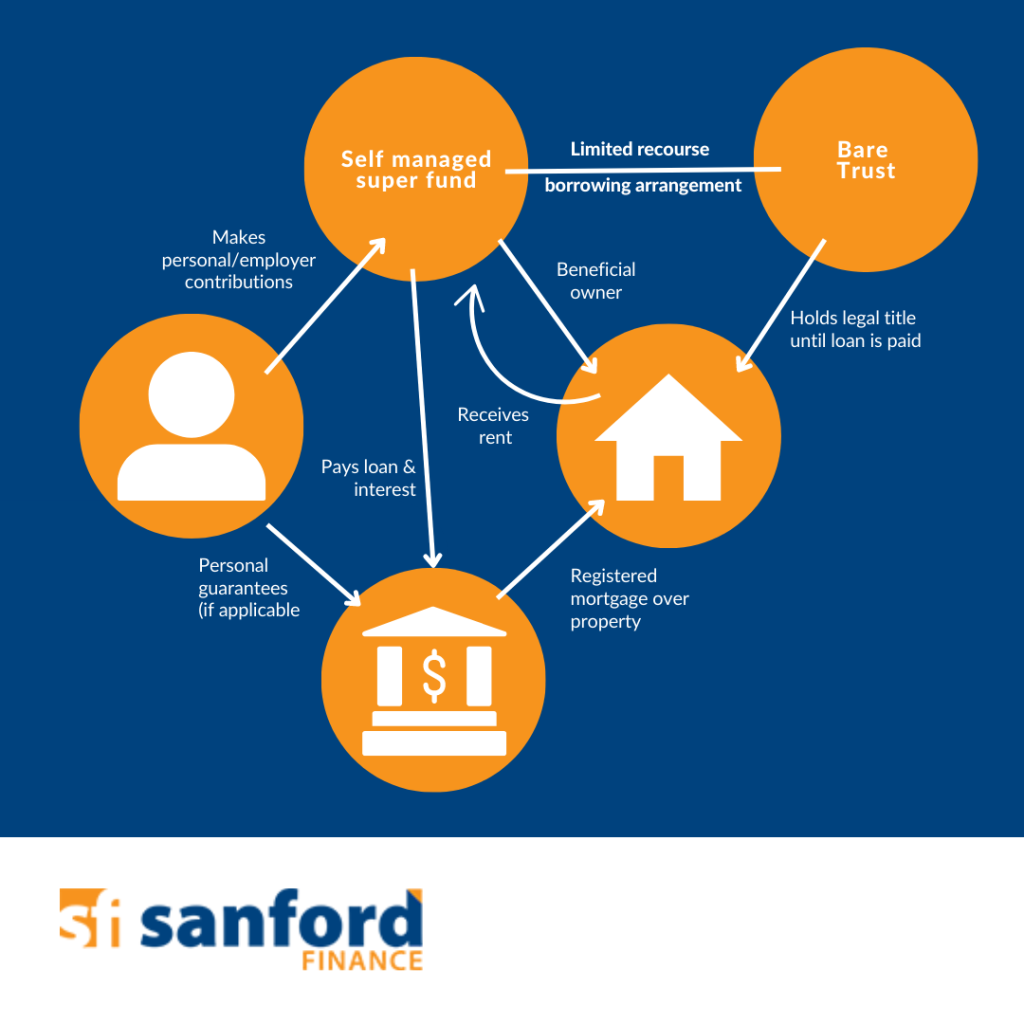
  • SMSF trustee: The SMSF trustee is responsible for making investment decisions and managing the SMSF’s assets. In an limited recourse borrowing arrangement, the trustee is also responsible for entering into the borrowing arrangement and ensuring that the loan is used for a permissible purpose. The trustee is also responsible for ensuring that the loan is repaid on time and that the SMSF remains compliant with all relevant legislation and regulations.
  • Lender: The lender is the entity that provides the loan to the self-managed super fund trustee. The lender may be a bank or other financial institution that specializes in providing SMSF loans. The lender’s recourse is limited to the asset purchased with the borrowed funds. This means that if the SMSF defaults on the loan, the lender can only take possession of the asset purchased with the borrowed funds, rather than pursuing the SMSF trustee for further payment.
  • Custodian: The custodian is a separate legal entity that holds the asset purchased with the borrowed funds on behalf of the self-managed super fund. The custodian is a crucial component of an LRBA, as it ensures that the asset is held separately from the SMSF’s other assets, and that the lender’s security interest is registered against the asset.
  • Bare Trustee: The bare trustee is another separate legal entity that holds the legal title to the asset purchased with the borrowed funds on behalf of the self-managed super fund. The bare trustee is a passive entity that does not have any decision-making power, and its only function is to hold the asset on behalf of the SMSF. 

How an LRBA Works: 

  • Separate Trust Structure: The property purchased through an LRBA is held in a separate trust (bare trust) until the loan is repaid. Once the loan is fully paid off, the property can be transferred to the SMSF.
  • Limited Recourse: If the SMSF defaults on the loan, the lender can only recover the loan from the property itself, protecting other assets within the SMSF. 
  • Loan Restrictions: The borrowed funds can only be used to acquire a single acquirable asset, and any improvements to the property must be funded by the SMSF’s own resources, not through additional borrowings.   

How Sanford Finance Can Assist 

Investing in property through an SMSF requires careful planning and expert advice. At Sanford Finance, we help you navigate the complexities of SMSF property investment, ensuring you understand both the benefits and risks involved. Our team of experienced brokers will work with you to assess your financial situation, guide you through the compliance requirements, and connect you with the right lenders who specialize in SMSF loans. 

Whether you’re considering purchasing your first SMSF property or looking to expand your existing portfolio, Sanford Finance is here to provide the expertise and support you need to make informed and confident investment decisions. 

Ready to explore SMSF property investment? Contact Sanford Finance today to schedule a consultation with one of our expert brokers. We’re here to help you achieve your retirement goals through smart, strategic property investments. 

Purchasing Property Through a Self Managed Super Fund

Purchasing Property Through a Self Managed Super Fund

Are you considering purchasing property through a Self-Managed Super Fund?

Purchasing property through a self-managed super fund (SMSF) can be a smart investment strategy for Australians looking to secure their retirement future – but it’s important to know what you’re doing.  

With the Australian property market experiencing consistent growth over the years, buying property through an SMSF can provide a range of financial benefits.

Source: https://www.realcrowd.com/post/reasons-to-invest

What are the benefits of purchasing property through a self-managed super fund?

One of the main advantages of purchasing property through an SMSF is the potential tax benefits. Income from rental properties held by an SMSF is generally taxed at a rate of only 15%, compared to the marginal tax rate that applies to individuals. This means that the rental income earned from an SMSF-owned property is taxed at a much lower rate, leaving more funds available for reinvestment or retirement income.


Other benefits of investing in property through a self managed super fund include:

  • Leveraging your investment by borrowing through limited recourse borrowing arrangements (LRBA)
    When investing in property through an SMSF, investors can leveraging their investment by borrowing money through limited recourse borrowing arrangements (LRBAs). This allows investors to purchase property with a smaller initial investment and to benefit from any capital growth over time.
  • Increased control over investments
    SMSF trustees can also benefit from increased control over their investments. Unlike traditional superannuation funds, SMSF trustees have direct control over the investment strategy and can make investment decisions in line with their specific goals and risk appetite. This level of control and flexibility can be particularly attractive to investors who want to take a more active role in managing their retirement savings.

What are the downsides of purchasing property through a self-managed super fund?

It’s important to note that investing in property through a self-managed super fund Is not without risks, including:

  • Fluctuating property values
  • The time and money involved in managing a property
  • The stress of dealing with leasing your property/choosing the right tenants/potential damage to property

With this in mind, it’s crucial that investors undertake thorough research and seek professional advice before making any investment decisions.

Is purchasing property through a SMSF right for me?

Overall, purchasing property through a self-managed super fund can be a sound investment strategy for those looking to diversify their portfolio, enjoy tax benefits and take greater control over their retirement savings. With the Australian property market showing consistent growth, SMSF trustees may find that investing in property is a smart move for their financial future.

If you’re interested in exploring your options and finding out more, get in touch! Sanford Finance has helped many clients secure property through their Self-Managed Super Funds as well as helped numerous clients with their general investment portfolios. We’ll work through the different options with you and find out which is best suited to your financial goals.

Get in touch with our team at www.sanfordfinance.com.au/contact or call us on 9095 6888