
Higher rates, gloomy budgets and cost-of-living pressure make for scary reading. But for long-term investors, Australia’s structural housing fundamentals point to opportunity for those who choose the right property in the right market.
The noise versus the numbers
Open any news app and Australian property looks like a minefield: higher interest rates, federal budget pessimism and relentless cost-of-living pressure. Yet the same period has seen national dwelling values continue their long-run climb, rents rise and a growing population competing for too few homes.
The lesson for long-term investors is simple: headlines are written to sell stories; data is what reveals reality. Short-term sentiment and long-term fundamentals are two very different things — and only one of them builds wealth over decades.
This issue looks at what the primary Australian data actually says about population, supply and rental demand, why periods of pessimism can favour disciplined buyers, and why the property and the market you choose matter far more than trying to time the cycle.
Four numbers that outlast the news cycle
| ~27.8 millionNational population | ~1.5%Annual population growth | ~79,000 homesProjected net housing shortfall to 2029 | ~5%+Long-run capital city capital growth (p.a.) |
Demand: more people, fewer homes
Australia’s population continues to grow, driven largely by net overseas migration. According to the Australian Bureau of Statistics (ABS), the national population is now approximately 27.8 million, growing at around 1.5% annually — with net overseas migration the largest contributor.
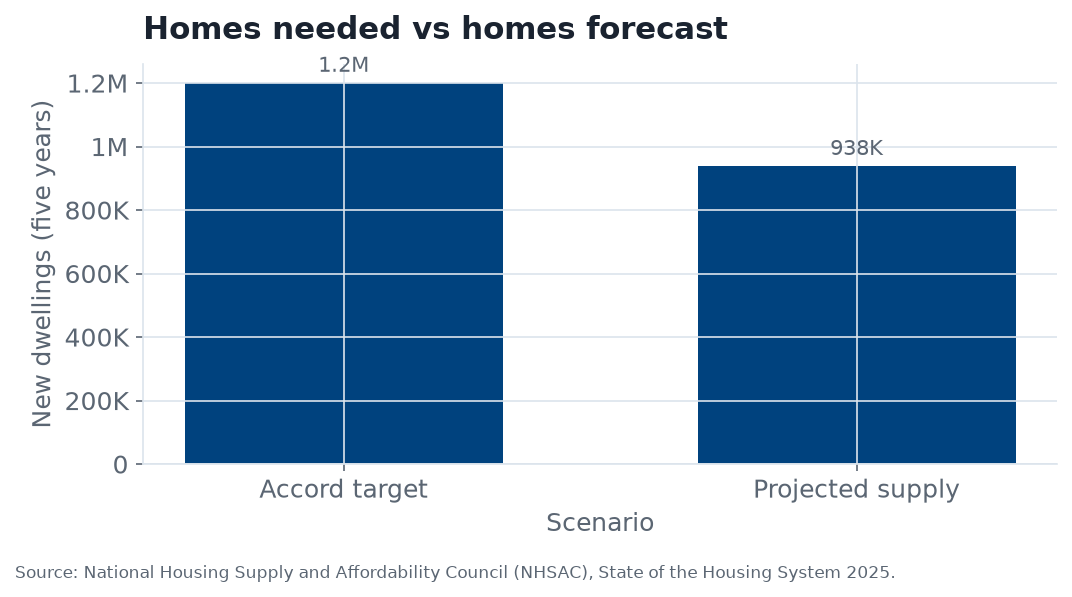
More people need somewhere to live, but new supply keeps falling behind. The National Housing Supply and Affordability Council (NHSAC) projects Australia will fall well short of the National Housing Accord target of 1.2 million homes: the forecast shortfall against the target is around 262,000 dwellings, and after allowing for demolitions, net housing supply is still expected to fall about 79,000 dwellings short of underlying demand by 2029.
When persistent demand meets constrained supply, the long-run pressure on prices and rents is structural — not a headline that disappears next quarter.
The supply gap the headlines ignore
The National Housing Accord set a target of 1.2 million new well-located homes over five years from mid-2024. The NHSAC projects around 938,000 completions — roughly 262,000 below the target. Measured as net supply against underlying demand, the shortfall is about 79,000 dwellings by 2029.
Rental demand keeps the pressure on
Tight supply shows up first in the rental market. National vacancy rates have sat well below the level generally considered balanced (around 3%), and asking rents have risen substantially over recent years, according to CoreLogic data.
For investors, this is the tangible side of the fundamentals: strong tenant demand, low vacancy and rising rents support holding costs — provided you own the right asset in the right location.
Why pessimism can be an opportunity
Higher interest rates and budget gloom feel like reasons to wait. History suggests the opposite can be true for the disciplined:
- Sentiment is cyclical; fundamentals are structural. Rate cycles come and go, but population growth and undersupply persist.
- Fear thins the field. When headlines scare hesitant buyers to the sidelines, committed long-term investors face less competition.
- Time in the market beats timing the market. Trying to pick the exact bottom is a losing game; consistent long-run participation is what has historically compounded wealth.
The Reserve Bank of Australia (RBA) sets the cash rate to manage inflation, and rate settings move through cycles. A single point in the cycle should not dictate a multi-decade investment strategy.
The core idea
Headlines sell stories. Data reveals reality.
— MVP Insight
Selection beats timing: the right property, the right market
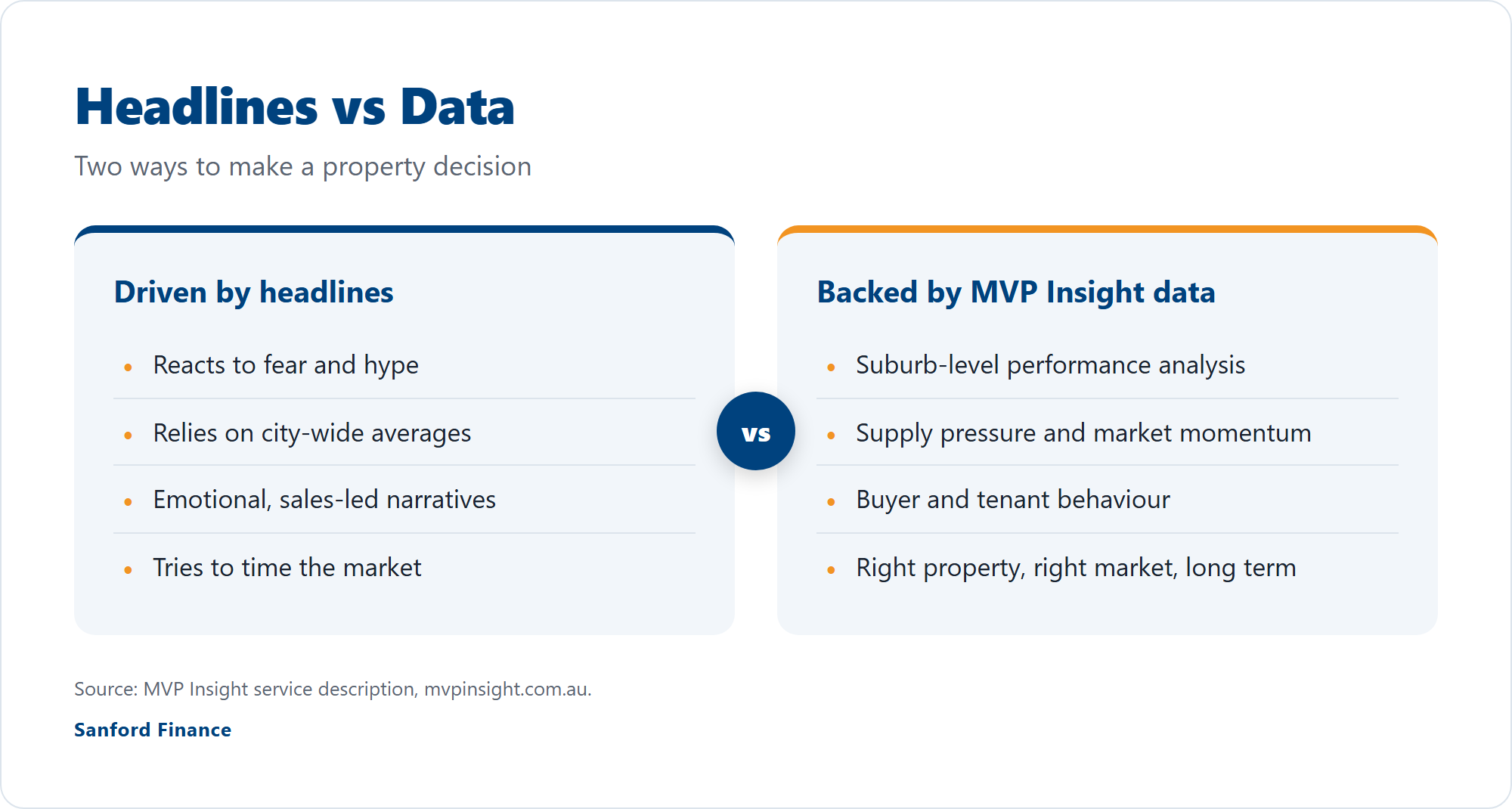
National averages hide enormous variation. In any given year, some suburbs surge while others stall — even within the same city. That’s why which property, in which market matters far more than the month you buy.
Getting selection right means understanding:
| Suburb performance and momentum, not just city-wide averages | Supply pressure — what’s being approved and built nearby |
| Buyer and tenant behaviour driving real demand | Asset quality at the individual property level |
This is analysis, not intuition. Emotion and sales-driven narratives are exactly what long-term investors need to filter out.
Two ways to choose a property
MVP Insight — Sanford Finance’s independent partner — replaces guesswork with evidence: Smarter Property Decisions. Backed by Insight.
How MVP Insight finds the RIGHT property
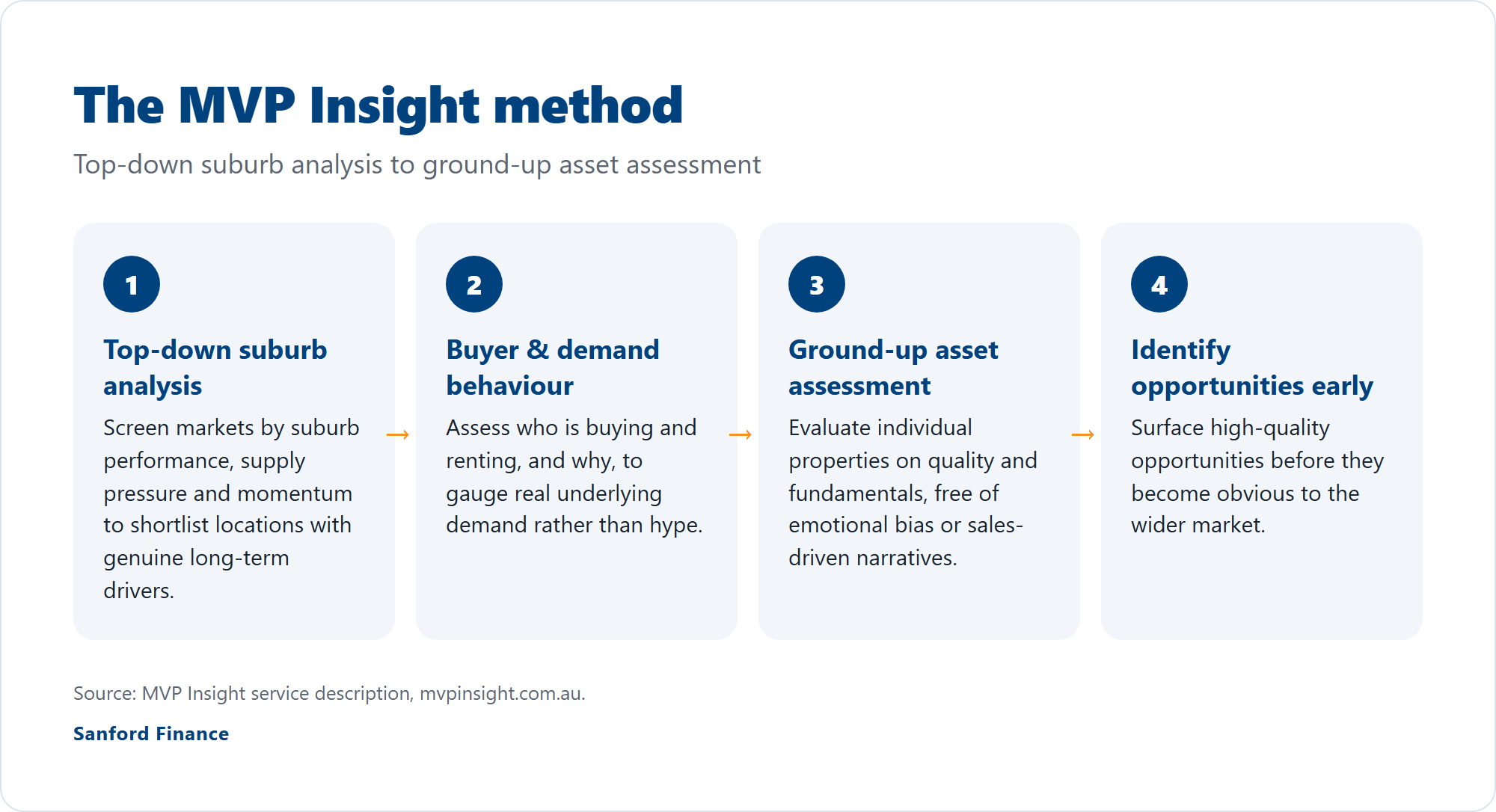
MVP Insight combines a top-down view of the market with a ground-up view of the individual asset — analysing suburb performance, buyer behaviour, supply pressure and market momentum to identify high-quality opportunities before they become obvious, without emotional bias or sales-driven narratives.
Find the right property. Fund it well.
This is where the pairing works for you:
- MVP Insight is an independent, data-driven property investment advisory and market-intelligence service. Its role is to help you find the right property in the right market — using data on suburb performance, buyer behaviour, supply pressure and market momentum, free of emotional bias or sales-driven narratives.
- Sanford Finance helps you fund it — structuring finance that supports a disciplined, long-term strategy.
Independent data to choose the asset; the right finance to acquire and hold it. Together, that’s a strategy built on evidence rather than headlines.
Thinking about your next investment property?
Book a property finance chat with Sanford →
This information is general only and does not take into account your objectives, financial situation or needs. It is not credit assistance or personal advice. Consider whether it is appropriate for you and seek professional advice before acting. Sanford Finance Pty Ltd — Australian Credit Licence 388372.